How to Track Pet Vaccinations and Vet Appointments
Record each pet's details once, then set recurring reminders before every booster and checkup, with a shared calendar so no vet date slips past you again.
Home & InventoryRecord each pet's core details once (name, date of birth, microchip number, vet contact, insurance), then set a recurring reminder a week or two before each booster, checkup and flea or worming treatment is due. Keep those reminders and the booked appointments in a shared household system so anyone at home can see what is coming and act on it, not just the one person who usually remembers. Your vet sets the actual schedule; this is the reminder layer that makes sure you act on it.
The rest of this guide shows you exactly what to record, how to turn one-a-year dates into reminders that hold, and how to keep it all working across two or three pets and more than one person in the house.
The annual booster date has a way of just passing you by. You meant to book it, the postcard from the vet went in the recycling, and then six months later you are filling in a kennel form that asks for the date of the last jab and you genuinely cannot remember. If you have ever felt that quiet flicker of guilt, you are not alone. Keeping on top of pet health admin is one of those jobs nobody officially owns, so it tends to fall through the gaps.
This guide is about fixing that, not with another folder of paperwork, but with a simple system for remembering the dates that matter. The aim is to never miss a booster or a checkup again, even when you have more than one animal and more than one person in the house who could, in theory, be the one to remember.
Why pet care is harder to track than it should be
The information itself is rarely the problem. Most owners know roughly when their dog is due, or have a vaccination card tucked in a drawer. The problem is that the knowledge lives in too many places, and the dates creep up quietly.
Think about where your pet's details actually are right now. The microchip number is on a certificate from the breeder or rescue. The vet's phone number is somewhere in your call history. The insurance policy is a PDF in your email, or a paper booklet in the same drawer as the takeaway menus. And the all-important "when is the next booster due" is, more often than not, stored entirely in your head.
That works fine until life gets busy. Then a few things go wrong at once:
- The dates sneak up. A booster is an annual event, which means you only think about it once a year. There is no weekly rhythm to keep it front of mind, so it is easy to drift past the due date by weeks or months.
- Nobody owns the job. In a household, "whose job is it to remember" is rarely settled. One person assumes the other has it, and the appointment quietly does not get booked.
- The records are scattered. When the vet asks for the date of the last vaccination, or you need the microchip number in a hurry, you end up scrolling through photos of paper records you snapped months ago.
None of these are big failures. They are just small gaps that add up. The fix is not to try harder to remember. It is to stop relying on memory at all, and put the dates somewhere they will nudge you in good time.
What to keep track of for each pet
Before you can set up reminders, it helps to know what is actually worth recording. You do not need a clinical history for every animal. You need the handful of details you reach for in a hurry, plus the dates that determine whether your pet's protection is up to date.
A practical starting point looks like this:
| What to track | Why it matters | Where it usually lives now |
|---|---|---|
| Microchip number | Required at the vet, for travel, and if your pet ever goes missing | Breeder or rescue paperwork |
| Date of birth | Helps the vet judge age-appropriate care and lets you plan ahead | A rough memory, at best |
| Vet contact details | You want the number one tap away in an emergency | Call history or a fridge magnet |
| Next booster or vaccination date | The single date most likely to slip past you | Your head, or a postcard |
| Annual checkup date | Easy to skip when the pet seems well | Nowhere, often |
| Insurance policy | Needed fast when you are making a claim | A PDF in your email |
| Flea, worming, and other routine treatments | Recurring and easy to lose track of across multiple pets | Scattered receipts |
| Notes (diet, medication, quirks) | Useful for whoever takes the pet to the vet | In your head |
A couple of things are worth flagging. Microchipping is a legal requirement for dogs across the UK, and in England it has applied to cats since 10 June 2024 (rules in Scotland, Wales and Northern Ireland differ, so check your nation's guidance on GOV.UK; checked September 2026). Animal charities such as the PDSA explain microchipping and why it matters in plain terms too. The chip number is one detail genuinely worth having to hand rather than buried in old paperwork. And for the vaccination dates themselves, you will notice this guide keeps pointing you back to your vet. That is deliberate.
A note on schedules, and why your vet decides them
It is tempting to want a tidy, fixed timetable that says exactly which jab is due and when. The honest answer is that there isn't one that applies to every animal. The right vaccination schedule depends on your pet's species, age, breed, health, lifestyle, and where you live, and it can change over time. A puppy's early course looks nothing like an older dog's annual booster, and an indoor cat's needs differ from a cat that roams.
So this guide will not hand you a list of vaccines and intervals to follow. Your vet sets the schedule for each animal, and they are the only reliable source for it. What this guide does is help you remember the dates your vet gives you, so you actually act on them. Think of it as the reminder layer that sits on top of your vet's advice, not a replacement for it.
Building a reminder system that actually holds
Record the date once and let a recurring reminder do the remembering. Instead of trying to hold a once-a-year date in your head, you set it up the day your vet gives it to you, and it surfaces again at the right moment. The list of details is useful, but the reminders are what keep you ahead of the dates.
Capture each pet's core details once
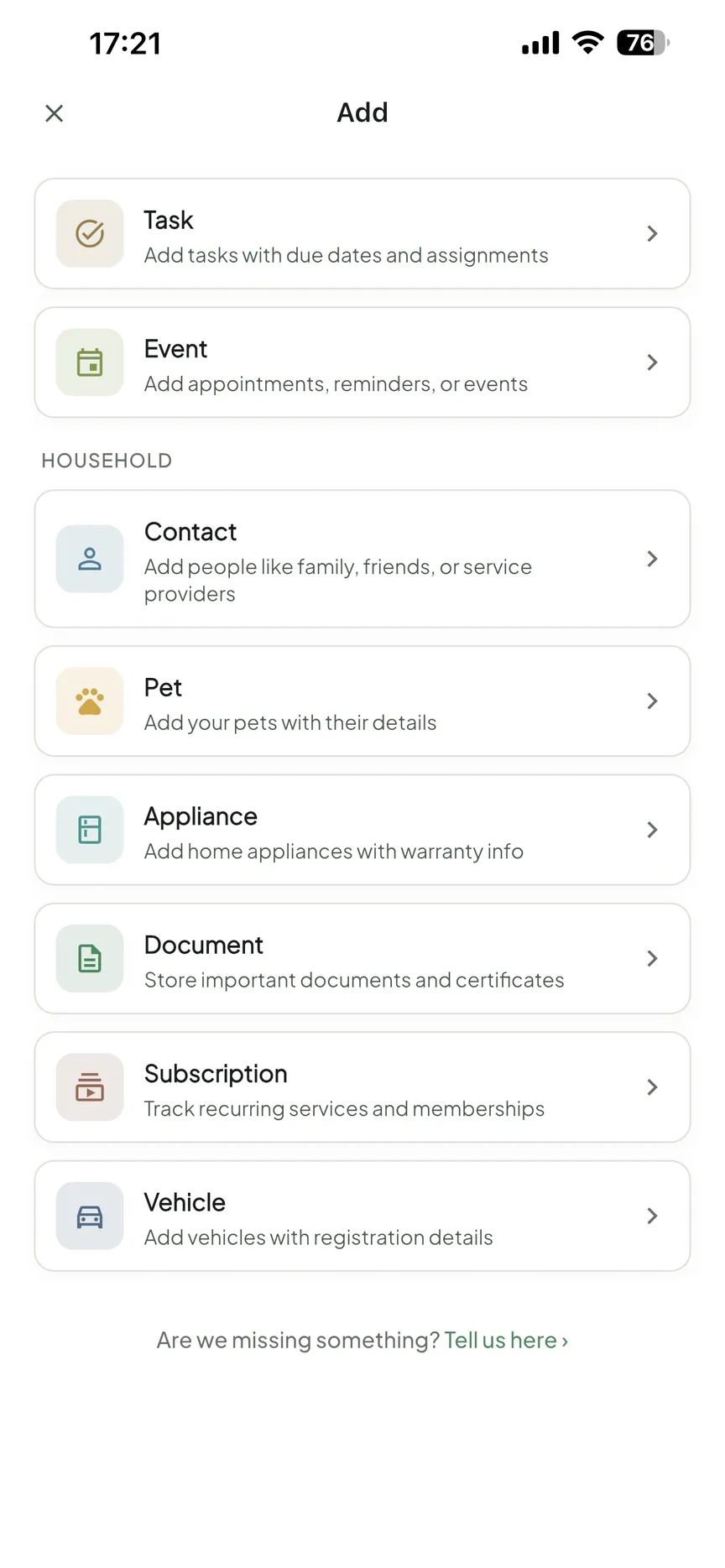
Start by getting the static information out of your head and the scattered drawers, and into one place. For each animal, record the name, date of birth, and microchip number. Save your vet as a contact so the number is genuinely one tap away when you need it. Link the insurance policy so you are not hunting through email at the exact moment you need to make a claim.
This is a ten-minute job per pet, done once. The payoff is that the next time anyone in the house needs the chip number or the vet's number, it is right there, no crouching on the floor reading the back of a vaccination card.
Turn the recurring dates into recurring reminders
The annual booster, the yearly checkup, the routine flea and worming treatments are all events that repeat on a known rhythm. Set them up as recurring reminders that fire well before the due date, not on the day.
A few principles make these reminders work rather than annoy:
- Give yourself lead time. A reminder two weeks before the booster is due is worth far more than one on the day. It gives you room to ring the vet, find a slot that suits, and actually attend, rather than scrambling.
- Be specific. "Book Bella's annual booster, ring the vet on 0123 456789" is far more likely to get acted on than a vague "vet stuff."
- Make it recur. Once you set the annual booster to repeat each year, you genuinely never have to think about scheduling the reminder again. It comes round on its own.
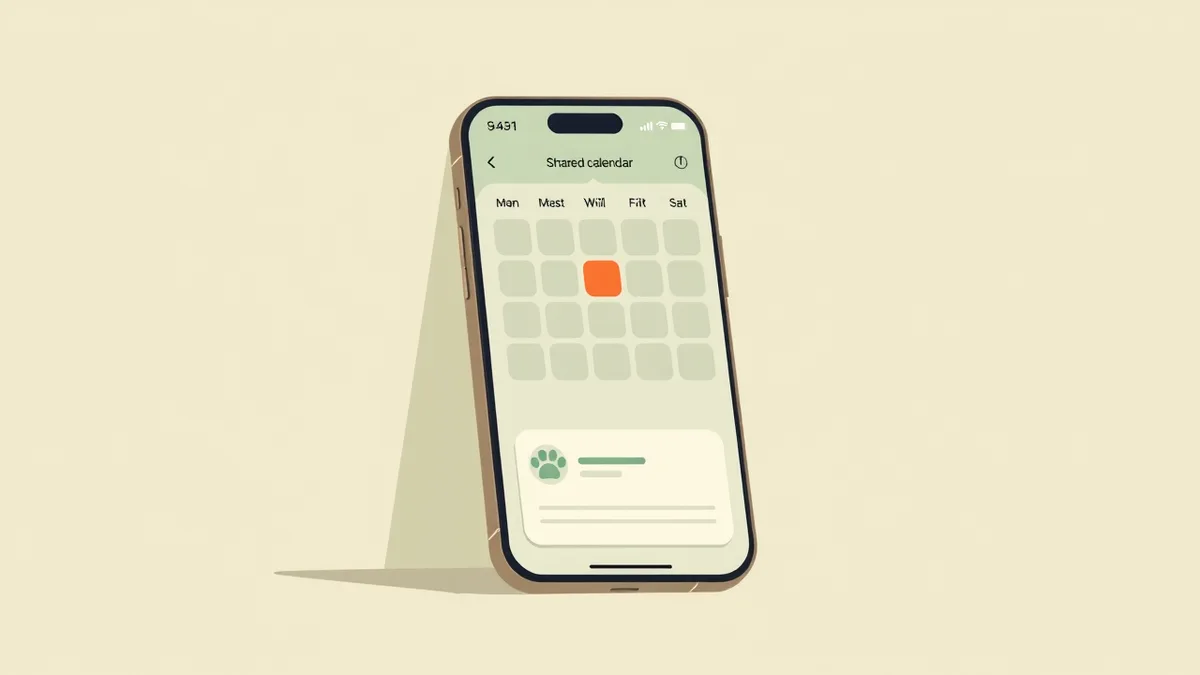
- Use the calendar for the appointment itself. Once the slot is booked, put it on the shared calendar so the whole household can see who is taking which pet where, and when.
The combination of a recurring reminder to book the appointment and a calendar entry for the appointment itself is what closes the loop. One nudges you to act in good time, the other makes sure the day does not clash with everything else going on.
Keep a light record as you go
You do not need a detailed medical log. But it helps to jot a quick note after each visit, the date of the booster, anything the vet flagged, the next due date. That way, when the kennels, groomer, or a new vet asks for the date of the last vaccination, you have it, and you are not relying on a half-remembered guess or a blurry photo of a card.
Keep proof of vaccination where you can find it fast
This is the moment the record earns its keep. Boarding kennels, catteries, doggy daycare, groomers, some dog-friendly venues, and most pet travel schemes will ask to see proof that vaccinations are current before they will take your pet. If the only copy is a paper card in a drawer, you end up rummaging the night before a trip. Save a photo or scan of the vaccination certificate and the microchip paperwork alongside the pet's details, so the proof is a couple of taps away whenever someone needs to see it. The same applies to rabies and tapeworm records if you ever travel abroad with a pet, where the dates and order of treatments matter.
Track weight and routine treatments too
Vaccinations are the headline, but they are not the only recurring date. A quick weight note at each visit, or a monthly weigh-in for an animal on a diet, helps you spot a problem early rather than at the next annual checkup. Ongoing medication is the other one people get caught out by: if your pet is on a regular tablet or a monthly spot-on treatment, set a reminder to reorder before the supply runs out, not on the morning you find the box empty. These are small habits, but they are exactly the gaps that a once-a-year mindset leaves open.
Managing a multiple pets vet schedule without losing your mind
One pet is manageable on memory alone, just about. Two or three animals, each on their own rhythm, is where things genuinely start to slip. The dog's booster, the cat's vaccination, two lots of flea treatment on different cycles, and a checkup for the rabbit, all landing in different months. Trying to hold a multiple pets vet schedule in your head is a recipe for missing something.
The system above scales to as many pets as you have, with a few extra habits. To make it concrete, here is how a real three-pet household might map out a year. Bella the dog, Max the cat, and Luna the rabbit each sit on their own rhythm, and once the reminders are set, nobody has to hold any of it in their head.
| Pet | Recurring reminder | Lead time | Falls due |
|---|---|---|---|
| Bella (dog) | Annual booster | 2 weeks before | March |
| Bella (dog) | Flea and worming | Every 3 months | Jan, Apr, Jul, Oct |
| Max (cat) | Annual vaccination | 2 weeks before | June |
| Max (cat) | Flea treatment | Monthly | Start of each month |
| Luna (rabbit) | Annual checkup and vaccination | 2 weeks before | September |
With Bella due in March, Max in June and Luna in September, the booster reminders are spread across the year, so you are never trying to book three appointments in one week. The flea and worming cycles tick along underneath on their own cadence. The point is not the exact dates, which are your vet's to set, but that each pet's reminders run independently and surface in good time.

Give every pet its own set of reminders
Do not lump the animals together. Each pet gets its own recurring booster reminder, its own checkup reminder, and its own treatment cycle. Name them clearly so a notification tells you instantly which animal it is about. "Max's dog booster reminder" and "Luna's cat vaccination record check" leave no room for confusion at a glance.
This matters most when the animals are on different schedules, which they almost always are. A reminder that names the pet means you can act on it without first having to work out who it refers to.
Stagger appointments where it makes sense
If you have several pets due around the same time, you have a choice. Sometimes it is easier to take two animals in one trip and get it all done. Other times it is gentler on everyone, pets included, to spread the visits out. Because each pet has its own reminder with sensible lead time, you can see what is coming and plan the trips on your terms rather than reacting to whichever postcard arrives first.
Stop it being one person's burden
This is the part that genuinely changes household life. When pet care lives in a shared system rather than one person's memory, the question of "whose job is it to remember" stops being a source of low-level friction.
If the booster reminder is visible to the whole household, then whoever is free that week can ring the vet. If the appointment is on the shared calendar, anyone can offer to take the cat in. Nobody has to be the one person who always ends up rebooking the missed booster, because the system is doing the remembering, not one exhausted member of the family.
It also helps when the unexpected happens. If you are away and the dog needs the vet, your partner can find the vet's number, the microchip details, and the insurance policy without ringing you in a panic, because it is all in the same place they already check for everything else.
Keeping pet care in the same place as the rest of household life
Plenty of apps exist that promise to store your pet's records. Some link straight to a partner vet clinic, others are standalone trackers with vaccination schedules and weight logs built in, and most do the core job well. The catch is that a single-purpose pet app is one more login that usually only one person in the house ever opens, sitting apart from everything else you use to run your home.
Pets are not a separate project. They are part of household life, alongside the car's MOT, the boiler service, the kids' activities, and the weekly shop. It makes sense for the dog's booster and the cat's checkup to sit in the same shared system as everything else, visible to everyone, on whatever phone they happen to carry. That way pet care is not an island. It is just another part of the household rhythm that the whole family can see and pitch in on.
If you are already tracking the household this way, adding your pets is a natural extension rather than a new habit to build. For the wider picture of recording what your household owns and manages, the home inventory tracking guide is a good companion to this one.
How OneHaus keeps your pets' care on schedule
OneHaus brings the whole system together in one place that your entire household can see, alongside everything else you manage at home. Pet tracking is built into the same subscription that covers your whole household, so adding the dog and the cat does not mean a separate app or a separate bill.
In the Home Inventory, you can add each pet with the details that matter:
- Core details: name, date of birth, and microchip number, recorded once and always to hand.
- Vet as a saved contact: link your vet from your Contacts & People list, so the number is one tap away when you need to call.
- Insurance and certificates as linked documents: attach the policy and a copy of the vaccination certificate, so the proof a kennel or travel scheme asks for is ready when you need it.
- Notes: dietary needs, medication, weight, or anything the vet should know.
For the dates themselves, you set up the reminders. Use OneHaus recurring tasks for the annual booster, the yearly checkup, and routine flea and worming treatments, with notifications that arrive before the due date so you have time to act. Put the booked appointment on the shared calendar so everyone can see who is taking which pet where. There is no vaccine database or automatic sync from your vet to do this for you, and that is rather the point. You set the dates your vet gives you, and OneHaus makes sure they do not slip past.
Because it all lives in the same shared household, pet care stops being one person's job. Anyone can see what is coming up and act on it.
Ready to get your pets' care on schedule? Start your free OneHaus trial and add your first pet in under ten minutes. OneHaus is available on iPhone, iPad, Apple Watch and Android, so the whole household can see what is coming up wherever they are.
Frequently asked questions
How do I keep track of pet vaccinations without a dedicated app?
You do not need a specialist app. Record each pet's core details, microchip number, date of birth, and vet contact, in one place, then set a recurring reminder for the booster and checkup dates your vet gives you. The key is to set the reminder to fire a week or two before the due date, so you have time to book. Letting a reminder do the remembering is far more reliable than trying to hold an annual date in your head.
Should I follow a standard pet vaccination schedule I find online?
No. There is no single schedule that fits every animal, and following a generic one online can leave your pet under- or over-protected. The right schedule depends on species, age, breed, lifestyle, and where you live, and only your vet can set it. Use online guidance to understand the general idea, but always get the actual dates and intervals from your vet, then record those dates so you act on them.
How do I manage a multiple pets vet schedule when they are all due at different times?
Give each pet its own set of clearly named reminders rather than lumping them together. A separate, named reminder for each animal's booster, checkup, and treatments means a notification tells you instantly which pet it is about. With sensible lead time built in, you can see what is coming and decide whether to combine visits into one trip or spread them out, rather than reacting to whichever reminder lands first.
How can I set up a vet appointment reminder the whole family can see?
Use a shared household system rather than a personal phone alarm. When the reminder to book and the appointment itself live somewhere everyone can see, anyone who is free can ring the vet or take the pet in. This removes the awkward question of whose job it is to remember, and spreads the mental load across the household instead of leaving it with one person.
Where should I keep my cat vaccination record and my dog's booster dates?
Keep the static details, microchip number, date of birth, vet contact, and insurance, in one place you can reach quickly, and keep the dates as recurring reminders rather than a static list. A quick note after each visit recording the date of the last jab and the next due date means you always have the information when the kennels, groomer, or a new vet asks for it.
Is microchipping really required in the UK?
Microchipping has long been a legal requirement for dogs across the UK, and in England it has applied to cats since 10 June 2024. Rules in Scotland, Wales and Northern Ireland can differ, so check your nation's guidance on GOV.UK (checked September 2026). Beyond the legal side, the chip number is genuinely useful to have recorded, your vet may ask for it, you need it for travel, and it is the detail that helps reunite you with your pet if they go missing. Storing it somewhere accessible, rather than on a certificate in a drawer, means it is there when it counts.
How do I keep proof of vaccination for boarding or travel?
Save a photo or scan of the vaccination certificate alongside your pet's other details, so it is a couple of taps away rather than buried in a drawer. Boarding kennels, catteries, daycare, groomers and pet travel schemes will usually ask to see that vaccinations are current before they take your pet, sometimes at short notice. Keeping the certificate and the microchip paperwork in the same place you check for everything else means you are not scrambling the night before a trip.