UK Car Maintenance Schedule: What to Track and When
A practical UK car maintenance schedule: MOT, road tax, service intervals and consumables, plus how one shared place keeps your household on top of it all.
Home & InventoryYour UK car maintenance schedule at a glance
If you came here for the dates, here they are. The full reasoning, the fuel-type differences and the by-age schedule follow underneath, but this is the baseline a typical UK petrol or diesel family car works from. Adjust it to your handbook, your mileage and how the car is used.
| What to check | How often | Notes |
|---|---|---|
| Tyre pressure and tread | Monthly | Legal minimum tread is 1.6mm; check before long trips |
| Oil and coolant levels | Monthly | Top up between services; watch for leaks |
| Screen wash and wipers | Monthly | More often in winter when roads are salted |
| Lights (all of them) | Monthly | A blown bulb is an easy MOT failure |
| Interim service | Every 6 months or 6,000 miles | Oil, filter and basic safety checks |
| Full service | Annually or every 10,000 to 12,000 miles | Whichever comes first; follow the handbook |
| Major service | Every 2 years or around 24,000 miles | Adds time-based items like brake fluid and coolant |
| MOT | Annually, from the car's 3rd birthday | Book a week or two before the due date |
| Road tax (VED) | Per your payment plan | Monthly, six-monthly or annual; doesn't transfer on sale |
| Insurance renewal | Annually | Compare before auto-renewal kicks in |
| Brake pads and discs | Checked at each service | Replace on wear, not on a fixed date |
| Battery | Every 3 to 5 years | Test before winter; cold weather exposes a weak one |
| Cambelt (if fitted) | Per manufacturer, often 60,000 to 100,000 miles or 4 to 6 years | Expensive to ignore, very expensive to skip |
| Air conditioning re-gas | Every 1 to 2 years | Optional but keeps it working in summer |
The exact figures matter less than the habit. A car that gets a monthly five-minute walk-around and a service when it's due will throw up far fewer nasty surprises than one that only sees attention when something fails.
A car maintenance schedule is just knowing which dates matter, roughly how often each one comes round, and keeping them in one reliable place, ideally alongside everything else your household has to remember. The rest of this guide explains the categories behind that table, how the schedule shifts by fuel type and car age, and how to make sure the dates actually get acted on.

What a car maintenance schedule actually needs to cover
People often reduce car upkeep to "the MOT and a service now and then". In reality there are four distinct categories of deadline, and they behave differently. Treating them as one lump is how things slip.
Legal deadlines
These are non-negotiable and carry penalties if you miss them. In the UK, a car needs its first MOT when it turns three years old, and then annually after that, as set out on GOV.UK. Road tax, properly Vehicle Excise Duty (VED), must be paid even if the amount is zero for your vehicle, and it doesn't carry over automatically when you buy a car second-hand. Insurance is the third: driving uninsured is an offence in its own right, and the renewal date is easy to lose track of when policies auto-renew quietly in the background.
Miss the MOT and you can't legally drive the car except to a pre-booked test. Miss the tax and you risk a fine and a clamped car. Miss the insurance and the consequences are worse still. These are the dates that justify the whole exercise.
One bit of good news for 2026 (checked June 2026): the maximum MOT fee for a standard car stays frozen at £54.85, the same cap that has held since 2010, with garages free to charge less (GOV.UK MOT fees). The headline plan to push a car's first MOT back from three years to four was scrapped, so the first MOT still falls at three years.
Servicing and mechanical upkeep
A manufacturer's service schedule is usually defined by time or mileage, whichever comes first, often around once a year or every 10,000 to 12,000 miles. A full service, an interim service and an oil change are not the same thing, and skipping them quietly shortens the life of the car and can void parts of the warranty. The MOT only checks that the car meets a minimum safety standard on the day. It is not a service and won't tell you the cambelt is overdue.
Consumables and wear items
Tyres, brake pads, wiper blades, the battery, coolant and screen wash all wear out on their own timetable. None of them has a fixed date, but they all have a rough lifespan, and catching them early is cheaper than catching them late. A tyre below the legal 1.6mm tread depth is both an MOT failure and a fine of up to £2,500 per tyre, a figure confirmed on GOV.UK, so this category isn't as casual as it sounds.
Seasonal and occasional tasks
Some jobs come round with the weather rather than the calendar. Checking antifreeze and battery health before winter, topping up screen wash when the salt and grime arrive, getting the air conditioning re-gassed every couple of years. They're easy to forget precisely because they're irregular.
Interim, full or major: which service and when
"A service" isn't one thing. Most UK garages work to three tiers, and knowing which is due saves you both overpaying and under-maintaining.
- Interim service roughly every 6 months or 6,000 miles. A lighter check-up, usually an oil and filter change plus a safety inspection. Worth doing if you cover high mileage or lots of short urban trips.
- Full service every 12 months or around 12,000 miles. The standard the AA and most manufacturers point to, with more filters, fluid checks and a fuller mechanical inspection.
- Major service every 2 years or about 24,000 miles. Adds the time-based items that don't need touching annually, such as brake fluid and coolant replacement and spark plugs on many petrol engines.
One point that catches people out: low mileage does not stop the clock. Manufacturers almost always say "time or mileage, whichever comes first" because engine oil degrades on its own. Moisture, fuel dilution and oxidation happen even in a car that mostly sits on the drive, so even a low-mileage car still needs annual attention.
How the schedule changes by fuel type
The table above is a sensible petrol baseline. The picture shifts depending on what's under the bonnet.
- Petrol follows the classic 12 months or 12,000 miles rhythm, with spark plugs typically due around 4 to 6 years.
- Diesel often benefits from more frequent oil changes because of soot loading on the diesel particulate filter (DPF). If you do mostly short urban runs, the DPF doesn't get the chance to regenerate, so an occasional 20 to 30 minute run at sustained motorway speed helps. Euro 6 diesels also use AdBlue, roughly a litre every 600 to 1,000 miles, which is another consumable to keep topped up.
- Electric and hybrid vehicles still need servicing, generally less often. With no engine oil or spark plugs, an EV can go longer between garage visits, but brakes, tyres, coolant and cabin filters still need checking. A hybrid keeps a petrol engine, so it follows the usual oil and filter schedule on top of its battery side.

A service schedule by car age
Maintenance needs change as a car gets older, and a schedule that made sense at year one leaves gaps by year eight. A rough by-age view:
- Years 0 to 3. Annual servicing, with brake fluid often changed at the two-year mark. Use the correct oil grade, keep every invoice, and make sure any software updates get applied. The first MOT lands at the end of this window.
- Years 3 to 6. Cabin filters every one to two years, spark plugs on applicable petrol engines around 4 to 6 years, diesel fuel filters, and battery testing all start to matter.
- Years 7 to 10. The timing-belt replacement window opens on many cars, automatic gearbox fluid changes get recommended, and suspension and brake inspections step up.
- 10 years and beyond. Shorter gaps between inspections, with attention on rust, wheel bearings, engine mounts and thermostats.
Driving conditions tilt all of this. Short urban journeys, heavy traffic, towing and lots of cold starts accelerate wear, so a car used that way benefits from more frequent attention than the mileage alone suggests. The single most reliable source for your exact intervals is still the owner's handbook, which always takes precedence over a generic schedule.
Keeping up with all of this isn't only about avoiding breakdowns. A documented service history protects resale value, and skipping services raises your odds of an MOT failure later. Drop these dates into a shared OneHaus household so nobody has to remember them, and add your vehicle in a couple of minutes.
How to keep track of car maintenance without it taking over
Knowing the schedule is the easy part. The hard part is keeping track of it all across a busy year, when the car is just one of a dozen things competing for attention. Here are the common approaches, in rough order of how well they hold up.
| Approach | What works | Where it falls down |
|---|---|---|
| Glovebox and inbox | No setup; documents are where you left them | Buried reminders; nothing nudges you; dates are hard to find in a hurry |
| Paper wall planner | Dates are visible at a glance | Shows one year only, lives in one room, nobody updates it, no nudge |
| Phone calendar reminders | Free, easy, alerts you ahead of time | Holds a date and a title, not the registration, VIN, policy number or documents |
| Shared household log | Dates plus details plus reminders, visible to everyone | Needs an app built for it rather than a single-vehicle car tracker |
Putting the MOT date in your phone calendar with an alert a fortnight ahead is genuinely useful, and it's the single highest-value thing you can do today if you do nothing else. The limitation is that a calendar entry is just a date and a title. You get the nudge but not the information.
The version that actually holds up treats the car the way you'd treat any other household responsibility: a service log with the details and the dates together, reminders that fire before each deadline, and a record the whole household can see rather than something locked in one person's phone.
This is the part that's easy to miss. Plenty of dedicated car apps will happily track multiple vehicles in great detail. But your car's MOT doesn't sit in isolation in real life. It sits next to the boiler service, the passport that's expiring, the kids' term dates and the home insurance renewal. Car upkeep works best when the car's deadlines live in the same place as everything else the household is trying to remember, so the person booking the MOT is whoever happens to be free that week, not whoever owns the one app it's stored in.
Why the whole household should see the car's deadlines
Cars tend to become one person's responsibility by accident. Whoever set up the insurance, or whoever drives it most, ends up as the unofficial keeper of every date. That works until they're away, or busy, or simply forget, and then nobody else has the information to step in.
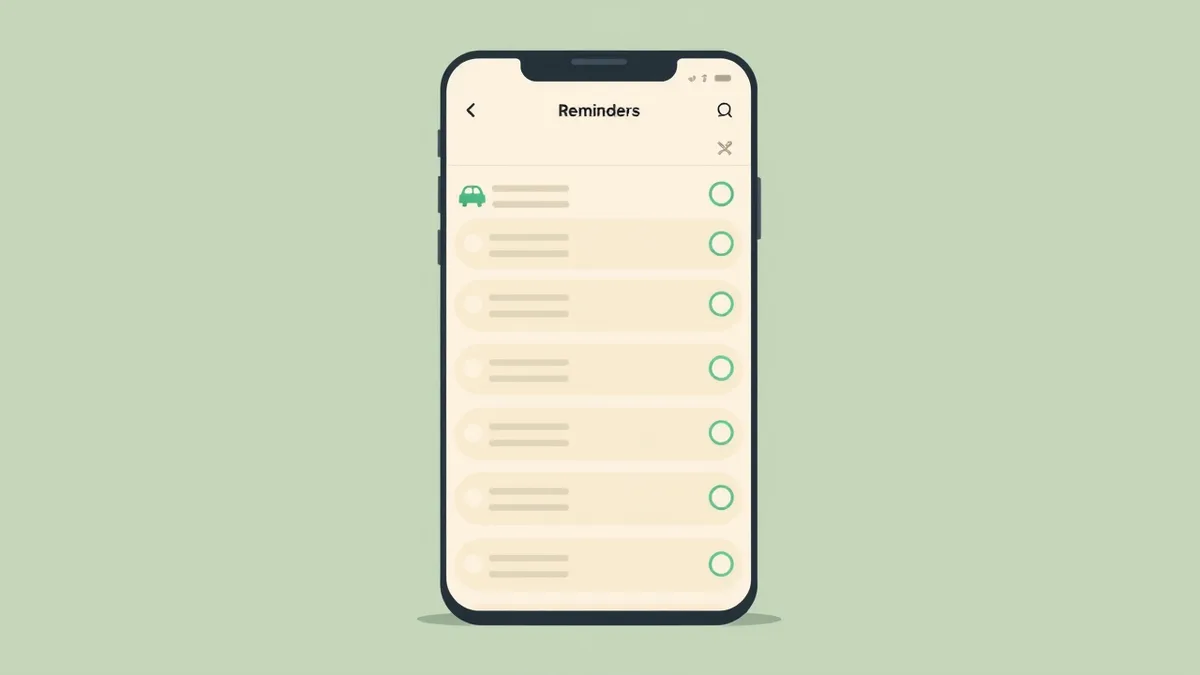
When the car's details and deadlines are visible to everyone in the household, the failure mode disappears. Your partner can book the service while you're at work. A teenager old enough to drive can check when the tax is due. If the car needs collecting from the garage and you're tied up, whoever picks it up already knows the registration and the policy details. The MOT stops being a thing one person has to remember and becomes a thing the household simply knows.
It also makes handovers painless. Selling the car, lending it to a relative, or adding a second driver to the insurance all go more smoothly when the facts aren't trapped in someone's memory. The aim isn't to build a perfect database. It's to get the dates that carry fines and the details you'll need under pressure out of one person's head and somewhere the rest of the household can reach them.
Building your schedule: a simple starting point
You don't need to set all of this up in one sitting. Start with the deadlines that carry the heaviest consequences and build outward.
- Record the three legal dates first. MOT due date, road tax renewal, insurance renewal. These are the ones that cost you money or take the car off the road if you miss them.
- Add the details you'd hunt for in a panic. Registration, make, model, year, VIN and colour. The VIN and registration are exactly what you'll be asked for during an insurance claim or a parts order, and you don't want to be crouched by the windscreen reading it off the plate at the time.
- Note the service interval. Whether it's annual or mileage-based, write down when the last service was and roughly when the next is due.
- Set a reminder ahead of each date. A fortnight is usually enough lead time to book an MOT or shop around for insurance rather than auto-renewing.
- Store the insurance document somewhere you can find it. The policy itself, not just the date, so the cover details are to hand when you need to make a call.
If you'd rather plan the wider picture first, the free home maintenance planner is a good way to map out recurring household deadlines, the car included, before you commit to a system.
How OneHaus keeps your car deadlines on track
OneHaus is a household management app, not a dedicated car app, and that's the point. It lets you track your car in its Home Inventory as a vehicle, with the make, model, year, registration, VIN, colour, and the dates that matter: MOT due date, road tax due date and service due date. You can store the insurance policy itself as a document and link it straight to the vehicle, so the cover details are one tap away rather than buried in an email thread. There's a notes field for anything else worth recording, from the tyre size to the locking wheel nut location.
OneHaus sends reminders before those due dates, so the MOT, the tax and the service surface in good time rather than slipping past. Because the vehicle's details sit in the shared household, the whole family can see them. It isn't all locked in one person's phone or memory. On OneHaus Pro, you can also just ask the in-app AI assistant something like "when is the car's MOT due?" and get an answer back in plain language.
The real value is what surrounds it. The car's MOT reminder sits next to the boiler service, the passport renewal and the home insurance, so the household has one place for the dates it can't afford to forget rather than a separate app per responsibility. If you want to extend the same thinking to appliances, warranties and documents, the home inventory tracking guide covers the rest of what's worth recording.
You do not have to set the schedule up by hand either. The Car Maintenance Task Pack turns the recurring jobs in this guide, checking the tires, checking the fluids, booking a service and renewing the insurance, into reminders against your vehicle in a couple of taps.
OneHaus is available on iPhone, iPad, Apple Watch and Android, with a free 30-day trial, after which a single subscription covers your whole household. To get your car's deadlines out of your inbox and into one shared place, download OneHaus and add your vehicle in a couple of minutes.
Frequently asked questions
How do I keep track of my car's MOT and service dates?
The most reliable approach is to record the dates somewhere with reminders, rather than relying on email alerts or memory. Note the MOT due date, the service interval and the road tax renewal in one place, set a reminder a fortnight before each, and keep the registration and insurance details alongside them. A shared household app means the whole family can see the dates, not just whoever set them up.
How often should a car be serviced in the UK?
Most manufacturers recommend a full service once a year or every 10,000 to 12,000 miles, whichever comes first, often with an interim service or oil change halfway between and a major service every two years or so. Always check your car's handbook, as the interval varies by make, model and engine. The service is separate from the MOT: the MOT only confirms the car meets a minimum safety standard on the day of the test.
Is an MOT the same as a service?
No. An MOT is a legal annual test that checks your car is safe and roadworthy at the time of inspection. A service is preventative maintenance, replacing oil, filters and worn parts to keep the car running well. Passing an MOT doesn't mean the car has been serviced, and a serviced car can still fail an MOT, so you need to track both separately.
When does a car need its first MOT?
In the UK, a car needs its first MOT when it reaches three years old, and then an MOT every year after that. The test must be valid for you to drive on public roads, with the only exception being driving to a pre-booked test. It's worth booking a week or two before the due date so a failure leaves you time to put any issues right.
Does road tax transfer when I buy a used car?
No. Road tax (VED) no longer transfers to the new owner when a car is sold. The seller gets a refund for any full remaining months, and the buyer must tax the car before driving it. This catches a lot of people out, so taxing the car should be one of the first things you do after buying it second-hand.
Do electric and low-mileage cars still need servicing?
Yes. Electric cars have no engine oil or spark plugs, so they go longer between visits, but brakes, tyres, coolant and cabin filters still need checking. Low mileage doesn't stop the clock either, because oil and fluids age over time regardless of how far you drive, which is why manufacturers say "time or mileage, whichever comes first".
How can the whole family keep track of car maintenance together?
Use a shared system rather than one person's notes or phone. If the car's details and due dates live in a household app that everyone can access, anyone can book the service, check the tax date or find the insurance policy when it's needed. This avoids the common problem of one person quietly becoming responsible for every car deadline, and nobody else having the information when they're unavailable.