How to Reduce and Share the Mental Load at Home in 2026
Practical ways to reduce and share the invisible mental load of running a home, so the remembering, planning and noticing stops falling on one person.
Family OrganisationThe mental load shrinks when you make the invisible work visible, share who owns each job, not only who does it, and stop using your own memory as the place where the household runs. Write down everything one person is silently tracking, hand over whole jobs instead of instructions, put recurring chores on an automatic rotation, and capture every new thing the moment it occurs to you. The rest of this guide walks through how.
The mental load is the work nobody sees. It is the remembering, the planning, the noticing and the coordinating that keeps a home running, and it almost always sits with one person. It is rarely shared evenly: a 2024 study from the University of Bath of 3,000 parents found mothers handle 71% of the household's mental-load tasks, against 45% for fathers. They are the one who knows the dishwasher tablets are nearly out, that the car is due its MOT next month, that the school trip needs paying for by Friday, and that nobody has thought about dinner. None of that shows up as a finished chore. It just lives quietly in their head, all day, every day.
If you have ever felt like the household manager rather than an equal partner in it, that is the mental load. And the reason it is so exhausting is precisely that it is invisible. You cannot share something nobody else can see. So the whole approach here comes down to one idea: make the invisible work visible, then share the ownership of it, and not only the tasks.
If you want a quick read on where your household stands before you start, take the free Mental Load Quiz. It takes a couple of minutes and gives you a clear picture of how lopsided things have become.
What the mental load actually is
It helps to be precise, because "I do everything" is easy to dismiss in a way that a written list is not.
Psychologists describe the mental load as cognitive household labour, the invisible planning and organising work that keeps a home running. It has three parts that usually get lumped together:
- The remembering. Holding dozens of facts and deadlines in your head at once, with no prompt from anyone else. Birthdays, repeat prescriptions, when the bins go out, which child has swimming kit on which day.
- The noticing. Spotting that something needs doing before it becomes a problem. The milk running low, the smoke alarm chirping, the fact that you have not seen the cat's flea treatment in a while.
- The coordinating. Turning all of that into a plan and keeping everyone on the same page. Deciding what happens when, who does it, and chasing it up when it does not.
The doing of a chore is visible and easy to split. The remembering, noticing and coordinating behind it are not, and that is the part that quietly wears one person down. So when someone says "just tell me what to do and I will do it", they are offering to take the visible part while leaving the invisible part exactly where it was.
Step 1: List the invisible work
You cannot share a load nobody can see, so the first job is to drag it into the open.
Sit down, ideally with whoever you share the home with, and write down everything one person is currently tracking. Not the chores themselves, but the mental work behind them. For example:
- Knowing when the car tax, insurance and MOT are due.
- Remembering birthdays and sorting cards and presents.
- Noticing when household supplies are running low.
- Keeping on top of appointments for everyone, including pets.
- Knowing what is for dinner this week and whether the ingredients are in.
Seeing it written down is often the moment the penny drops for the partner who genuinely did not realise how much was being carried. The list is the evidence. If you would rather start from a structured prompt, the Mental Load Quiz walks you through the common categories so nothing gets missed.
Step 2: Share ownership, not just tasks
This is the step that actually changes things, and the one most households skip. It is the heart of Eve Rodsky's Fair Play method, which argues that the real mental load lives in conceiving and planning a task, not in the doing, so handing over only the doing leaves the heavy part exactly where it was.
There is a world of difference between "can you put a wash on" and "you own the laundry". In the first, you are still the manager. You are still the one who noticed it needed doing, decided when, and will remember to chase it. In the second, the whole job, including the remembering and the noticing, moves off your plate entirely.
Owning a job means owning the full cycle, Fair Play's Conceive, Plan and Execute, plus the follow-up that keeps it from bouncing back:
- Knowing when it needs doing.
- Deciding how and when to do it.
- Actually doing it.
- Restocking or following up so it does not bounce back to you.
Hand over whole areas, not individual instructions. One person owns the bins and recycling. One person owns the weekly food shop and what the household eats. One person owns the kids' school admin. Once a job genuinely belongs to someone, you can stop holding it in your head, which is the entire point.
The hard part is resisting the urge to take it back the moment it is not done your way. Different is not wrong, and a job that lives in someone else's head is worth far more than one done to your exact standard but still managed by you.
Step 3: Put recurring jobs on an automatic rotation
A lot of the mental load is just the same handful of jobs coming round again and again. The bins, the bathroom, the food shop, changing the bedding. The remembering of when each one is due is pure overhead, and it does not need a human at all.
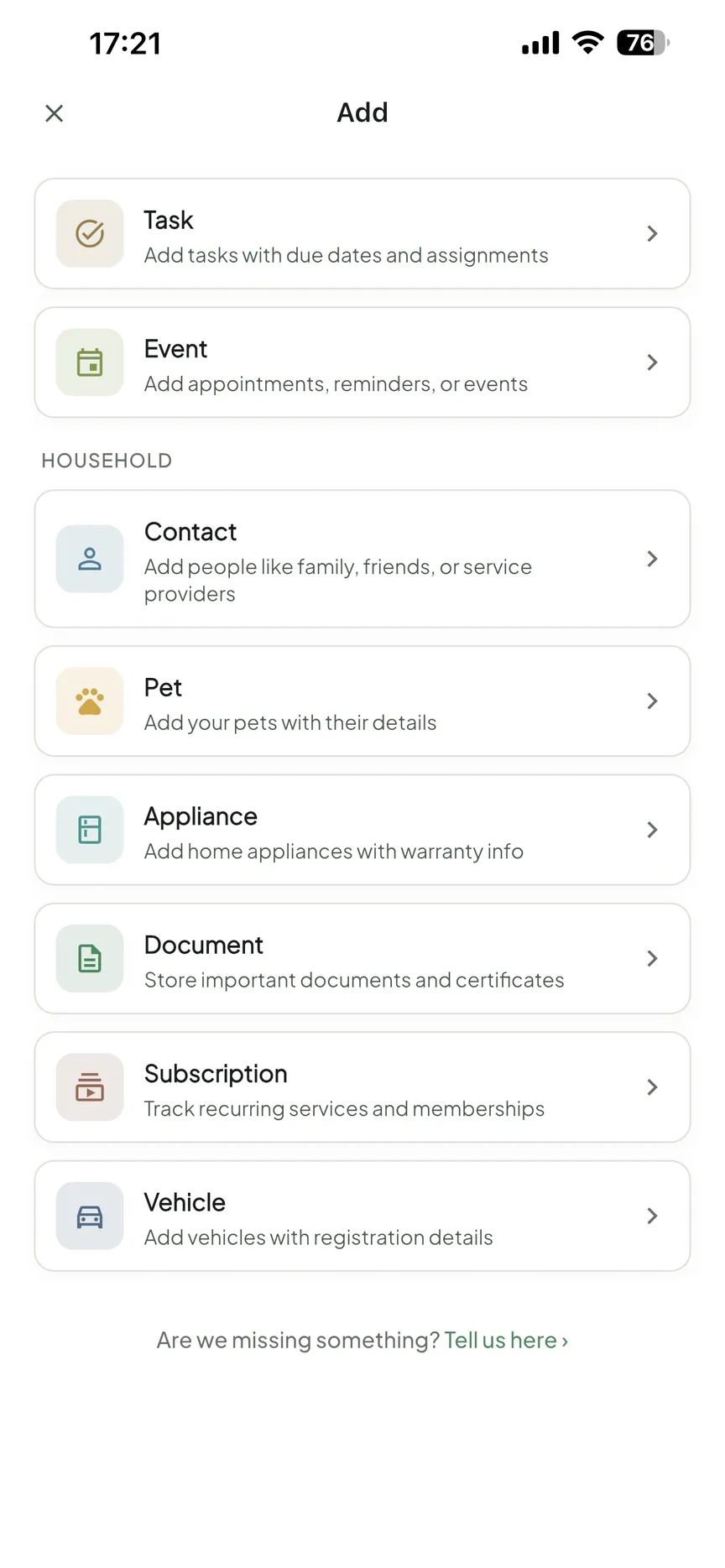
This is where a shared system earns its place. In OneHaus, you can set a chore to repeat on a schedule so it simply reappears when it is due, with no one having to remember it. For the jobs nobody wants to be permanently stuck with, you can turn on automatic rotation, so ownership moves fairly between household members each time the task comes round. The "whose turn is it" argument disappears because the system already knows, and the fairness is built in rather than negotiated every week.
That removes two invisible jobs at once: remembering when things are due, and keeping the split fair. If you want to check how even your current split is, the free Chore Fairness Calculator shows you in a couple of minutes.
Step 4: Make it visible to everyone
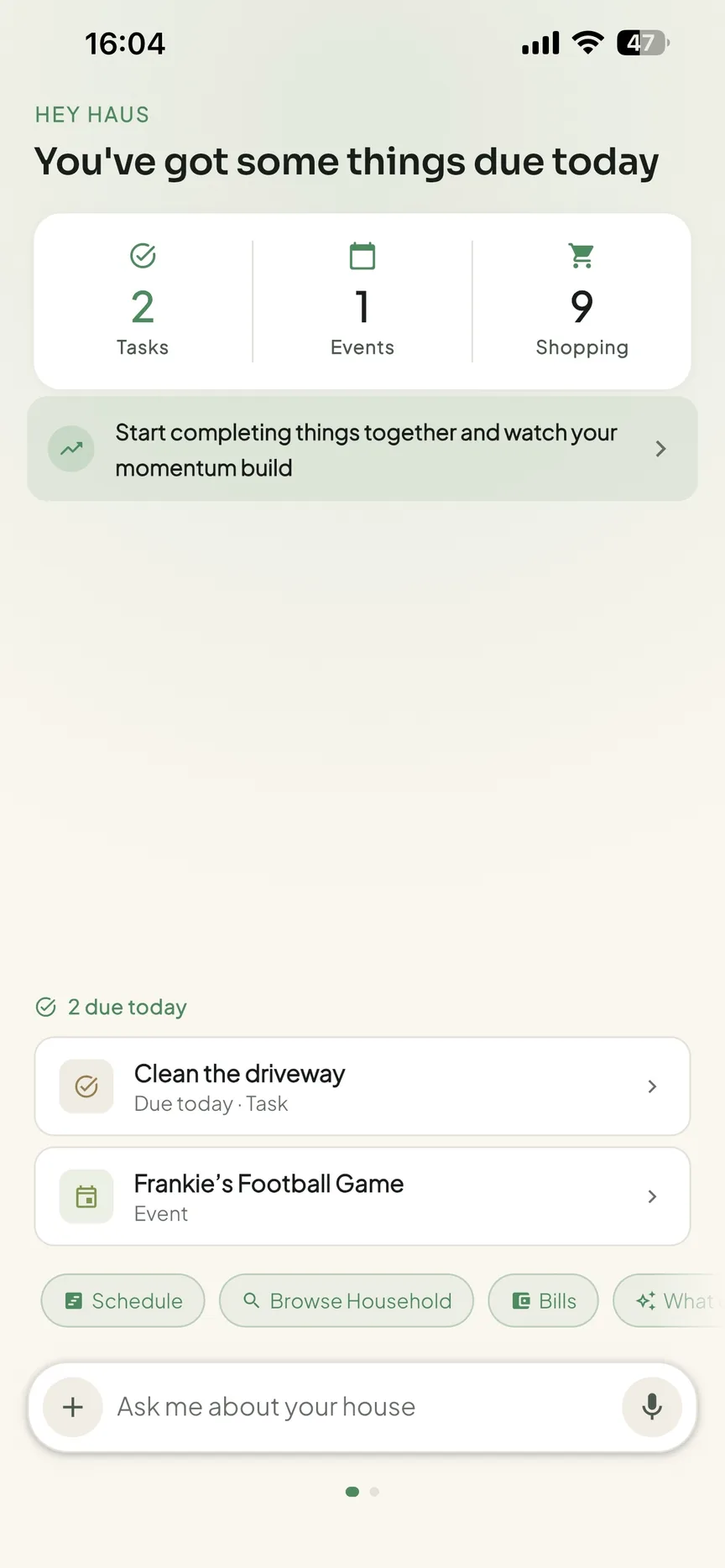
A load that only one person can see is still that person's load, even after you have shared it on paper. The cure is a single shared view that everyone in the household can open and read for themselves.
When the tasks, who owns them and when they are due all live in one shared place, nobody has to be asked what needs doing. They can just look. That quietly kills the most draining job of all, which is being the household's human noticeboard, repeating the same reminders out loud day after day.
A shared calendar does the same for time. OneHaus gives the whole household one calendar, and you can connect it to Apple Calendar or Google Calendar so appointments and commitments show up in the app you already use. The dentist appointment, the parents' evening, the weekend away: once it is on the shared calendar, it is no longer one person's job to remember and relay it.
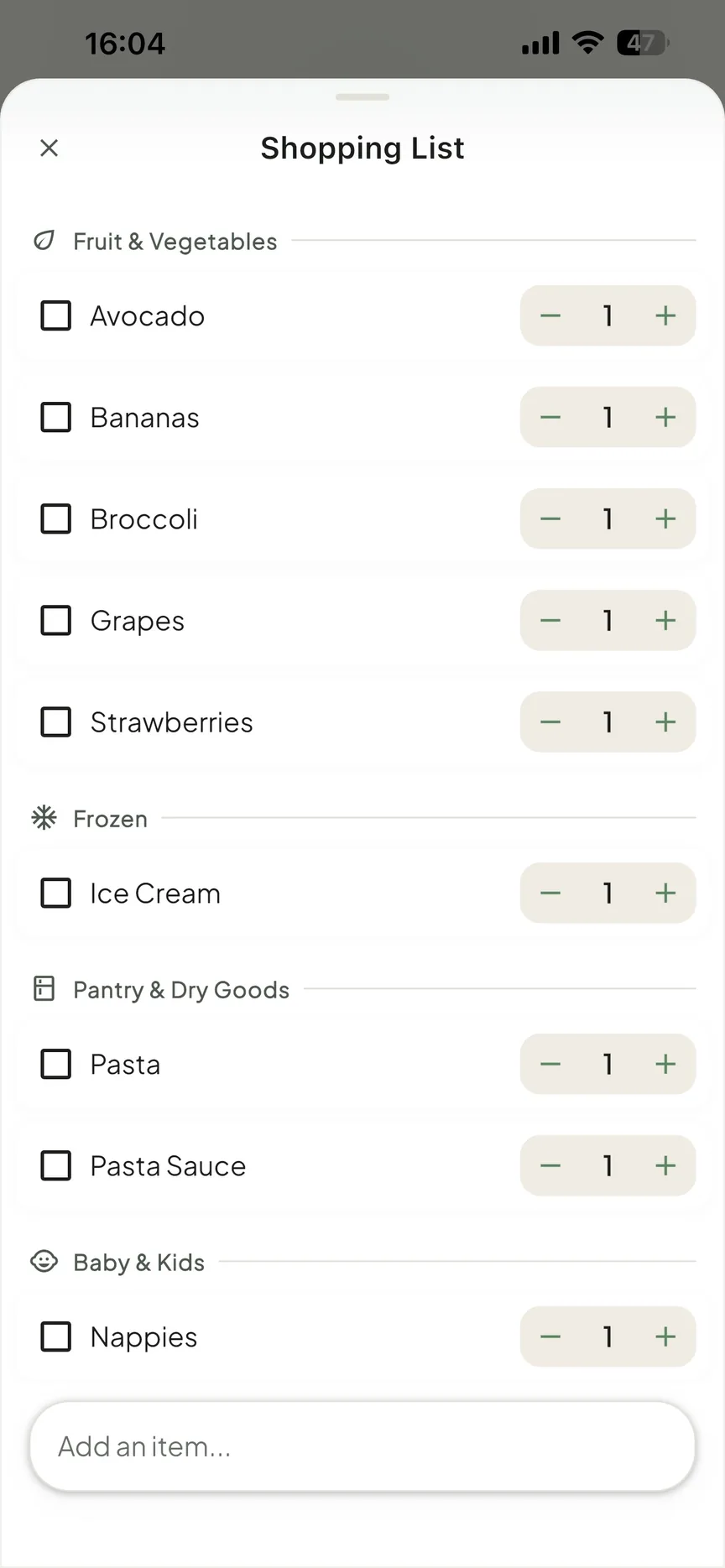
The same goes for the food shop. A shared shopping list means anyone can add the thing they noticed was running low the moment they notice it, and whoever is at the shops sees it, sorted by aisle so the trip is quick. The list does the noticing and the remembering, not a person.
Step 5: Use quick capture so things leave your head
Most of the mental load is not the doing. It is the low hum of trying not to forget the twenty small things that occurred to you today and have nowhere to go. The fix is to get every one of them out of your head the second it arrives, into somewhere you trust.
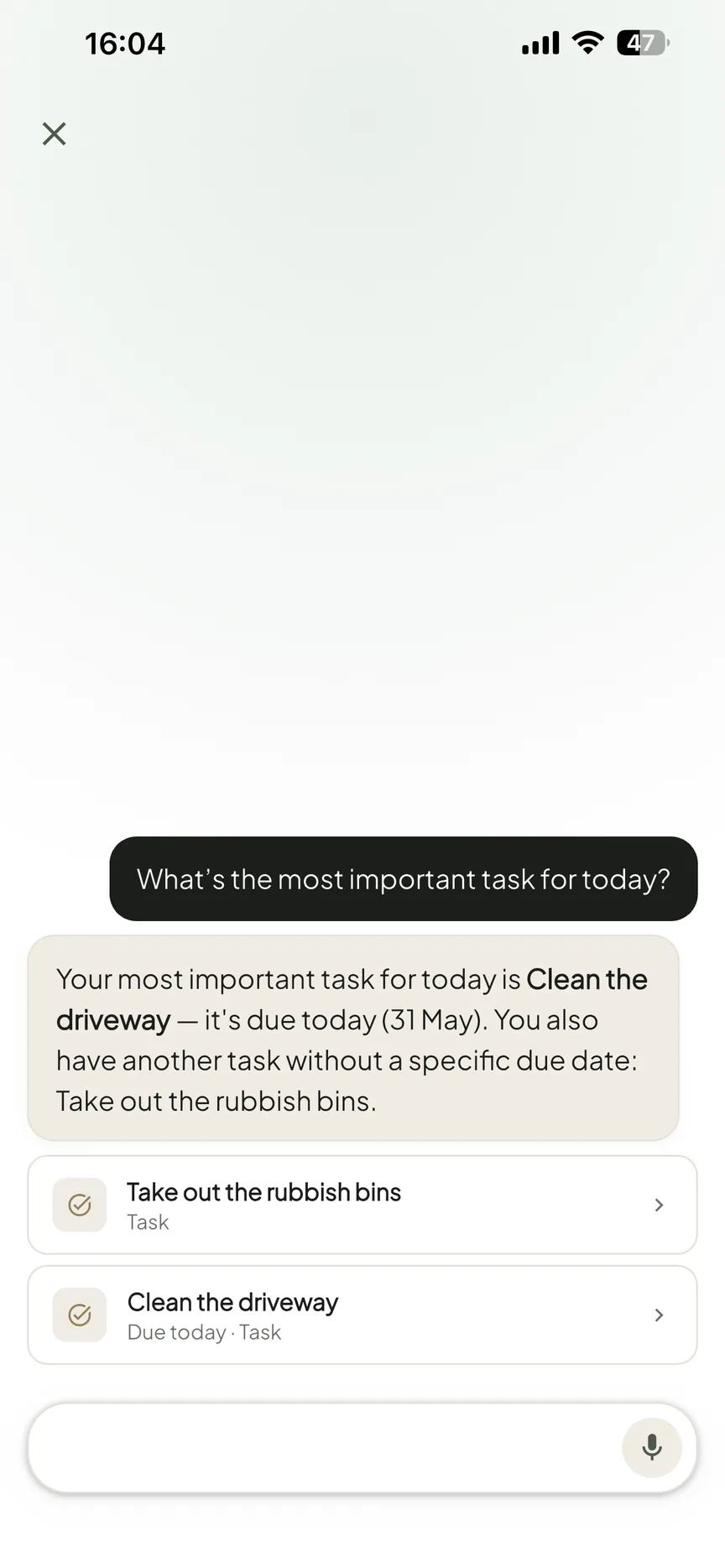
The trick is making capture so fast that you actually do it. OneHaus includes a natural language AI assistant, so you can just say or type a plain sentence like "remind me to book the dog's booster next week" or "add kitchen roll to the shopping list", and it creates the right task, event or list item for you. No menus, no forms, no friction.
That speed matters, because a thought you have to stop and file properly is a thought you will put off and then lose. When capture is a single sentence, the household stops living in one person's working memory and starts living in a system everyone shares. You can use the assistant in the app or in AI assistants you already use, so the half-formed thought goes somewhere the moment it lands.
Where to start this week
If five steps feels like a lot, start with the one that moves the needle fastest: this weekend, sit down together and hand over a single whole job, the full Conceive-Plan-Execute cycle, not just the doing. Rodsky's own advice is that re-assigning ownership of even one task can change the dynamic, because it proves the load can actually move. Once one job has genuinely left your head, the rest of the steps, the shared view, the rotation, the quick capture, become the scaffolding that keeps it there.
OneHaus is built to make that handover stick. Recurring tasks with automatic rotation keep ownership fair, a shared view means nobody has to be asked what needs doing, a natural language assistant makes capture a single sentence, and a shared calendar connects to Apple Calendar and Google Calendar so commitments are everyone's to see. OneHaus is available on iPhone, iPad, Apple Watch and Android, plus connected AI assistants.
Start by seeing where you stand with the free Mental Load Quiz and the Chore Fairness Calculator. Then, if you share a home, see how it works for two of you on the OneHaus for couples page, or for a busy house on the OneHaus for families page.
Frequently asked questions
What is the mental load in a household?
The mental load is the invisible work of running a home: the remembering, noticing, planning and coordinating that keeps everything on track. It is separate from the visible chores themselves, and it usually falls on one person because no one else can see it.
Why does the mental load fall on one person?
Because it is invisible. The doing of a chore is easy to split, but the remembering and noticing behind it sit silently in one person's head. Until that work is written down and shared, the rest of the household cannot see it, so it stays where it is.
How is sharing ownership different from sharing tasks?
Sharing a task means asking someone to do a specific thing you have already noticed and planned. Sharing ownership means handing over the whole job, including knowing when it needs doing and following up, so it leaves your head entirely rather than just borrowing someone's hands.
Can an app really reduce the mental load?
Yes, if it holds the remembering for you. A shared system that schedules recurring chores, rotates them automatically, shows everyone what needs doing and lets you capture new things in a sentence moves the load out of one person's head and into a place the whole household can see.
How do I get my partner to take on more of the mental load?
Start by listing the invisible work together so the scale of it is visible, then hand over whole areas rather than instructions. Putting jobs in a shared view with automatic rotation helps, because ownership and fairness are built in rather than something you have to keep managing.
What is a good first step to reduce the mental load?
Write down everything one person is currently tracking in their head. Seeing it on paper is what makes the load real and shareable. The free Mental Load Quiz gives you a structured way to do this in a couple of minutes.