How to Manage and Divide Household Chores Fairly as a Family
A practical guide to dividing, scheduling, and tracking household chores fairly so no one carries the load, with age-based tasks, rotations, and reminders.
Chores & CleaningHow do you divide household chores fairly as a family?
To divide household chores fairly as a family, do five things in order. Audit every recurring task together so the full list is visible. Split the work by who actually has time, not just who minds it least. Rotate the jobs nobody wants so no one is stuck with them forever. Match tasks to each person's age and ability, including the kids. Then schedule everything with reminders and track it in clear buckets (overdue, due today, this week, later) so the system runs itself instead of living in one person's head.
The rest of this guide explains each step, including age-appropriate chores for children and which fairness method (rotation, zones, or a points menu) suits your household.

Why "fair" is harder than it looks
Most chore arguments are not about the dishes. They are about the invisible work of remembering what needs doing, noticing when it is overdue, and planning ahead so nothing slips. This mental load usually lands on one person, and it is exhausting precisely because no one else can see it.
It also creates a perception gap. As TIME has reported, partners routinely overestimate their own share of the work, because the share they can see is only the visible half. The gap is not only in perception: in the US, women spend 12.6 hours a week on housework against 5.7 for men, around 2.2 times as much household and care work (Gender Equity Policy Institute analysis of 2022 Census data, published 2024). It is also one of the most common things households actually argue about: 49% of couples with young, kindergarten-aged children report arguing about chores and responsibilities often or sometimes, ahead of money (43%) and the kids themselves (41%) (Institute for Family Studies). The fix starts with making all of it visible, the tracking and reminding as well as the scrubbing and folding. If you want to see how the load splits in your home today, take our free mental load quiz.
How to divide chores fairly
Start with a full household audit
Before you can split anything, you need to know what every chore actually is. Sit down together and list each recurring task, from bins and laundry to booking the boiler service, renewing the car tax, and restocking the cupboards. People are usually surprised how long the list gets, and that is the point: half of it was previously invisible. Our complete list of household chores is a ready-made starting point, and the chore fairness calculator shows how the current split really looks.
Measure by time, not by task count
"Three chores each" feels fair and rarely is. Hoovering the whole house and emptying one bin are both one task, but they are not one job. Estimate roughly how long each task takes, then balance the totals. The honest yardstick is time spent, not boxes ticked.
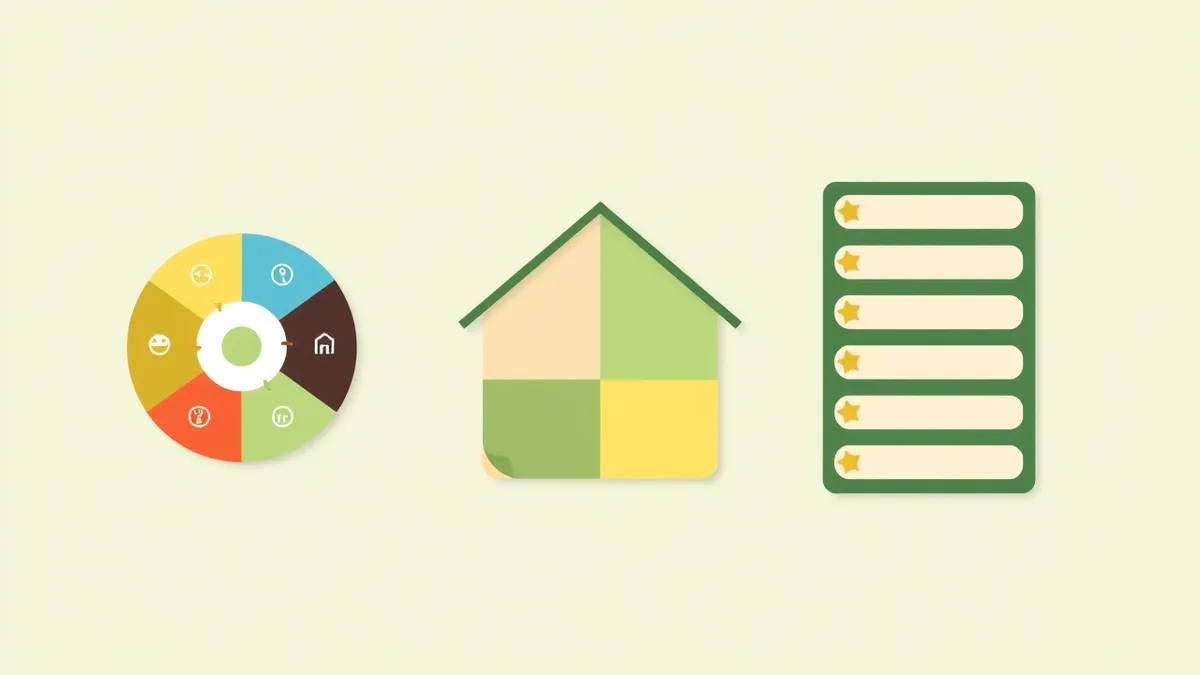
Pick a method: rotation, zones, or a points menu
There is no single right way to divide work. Three approaches dominate, and each suits a different household.
- Rotation cycles every person through every task week by week. It is the fairest feeling option because nobody owns the worst jobs permanently, and it teaches everyone every skill. Best for households where people have similar amounts of free time.
- Zones give each person a room or area to own, the kitchen, the bathrooms, the garden. It builds accountability and makes it obvious when something has slipped. Best when people have very different schedules and prefer to manage their patch on their own clock.
- A points menu assigns a value to each chore and lets people choose tasks up to a weekly target. It works brilliantly with children and teens because it gives them agency while still guaranteeing the work gets covered. Best for families wanting to motivate kids without nagging.
You can mix them: zones for the adults, a points menu for the kids, a rotation for the universally hated jobs.
| Method | How it works | Best for |
|---|---|---|
| Rotation | Everyone cycles through every task week by week | Households where people have similar free time |
| Zones | Each person owns a room or area | People with very different schedules who prefer their own patch |
| Points menu | Each chore has a value; people pick up to a weekly target | Families motivating children and teens without nagging |
Rotate the tasks nobody wants
Whatever method you choose, ring-fence the jobs everyone dreads (the bins, the bathroom, cleaning the oven) and put those on a rotation of their own. Taking turns on the worst tasks is what makes the whole split feel fair, even when the rest is fixed.
Two sample rotas you can copy
Seeing a real split makes the method above easier to apply. Here is one rota weighted by effort rather than job count, and one that spreads the work across the week by theme instead.
A two-person rota, balanced by effort. Give each task a rough effort score out of five (time plus hassle), then check the totals land close together rather than counting jobs.
| Task | Effort | Owner | When |
|---|---|---|---|
| Kitchen clean-down | 3 | Rotates | Daily |
| Bins and recycling out | 2 | Person A | Collection days |
| Bathroom deep clean | 4 | Rotates | Weekly (Sat) |
| Hoover and floors | 3 | Person B | Weekly |
| Laundry (wash, dry, put away) | 4 | Person A | Twice weekly |
| Meal planning and shopping list | 4 | Person B | Weekly (Sun) |
| Change bed linen | 2 | Rotates | Fortnightly |
Person A carries roughly 11 points of weekly effort, Person B around 11 as well, with the heavy rotating jobs shared. That is what a fair split looks like in practice: similar effort, even though the job counts and the actual tasks differ.
A day-themed weekly rota. Instead of splitting by task, this one spreads the work across the week so no single day carries the whole house.
| Day | Focus | Tasks |
|---|---|---|
| Monday | Floors | Hoover throughout, then mop the hard floors |
| Tuesday | Bathrooms | Loo, sink, shower or bath, mirror, restock loo roll |
| Wednesday | Washing and bed linen | Wash, dry and put away clothes, change the bed sheets |
| Thursday | Kitchen and bins | Deep-wipe surfaces and hob, clean the sink, take the bins out |
| Friday | Surfaces and dusting | Dust, wipe sideboards and shelves, tidy clutter |
| Saturday | Big reset | Catch-up on anything missed, a longer tidy, the jobs nobody fancies |
| Sunday | Rest | No scheduled chores, plan the week ahead if you like |
Copy either one as a starting template, then adapt the days and owners to fit your own household, bin collection schedule and number of people pitching in.
For housemates and flatshares
Shared houses have a problem families do not: nobody is in charge. There is no parent setting the rules, just a group of equals who all moved in around the same time, which makes a fair split more important, not less, because resentment in a flatshare has nowhere to go and tends to curdle quietly until someone moves out.
A few things make a flatshare split work:
- Separate shared chores from personal ones. Cleaning the communal kitchen, hoovering the lounge, scrubbing the shared bathroom and taking out the household bins are everyone's job. Washing your own plates, doing your own laundry and tidying your own room are not. Spelling out that line up front prevents the classic flatshare row about whose mess it actually was.
- Rotate the grim communal jobs. The shared bathroom and the kitchen bin are the flashpoints. Put them on a weekly rotation so each housemate takes a turn, rather than letting it default to whoever cracks first.
- Agree a standard, not just a schedule. "Clean the kitchen" means different things to different people. A quick shared note on what done looks like (surfaces wiped, washing-up done, floor swept, bin emptied if full) saves a lot of passive-aggressive moments.
When someone genuinely is not pulling their weight, the fix is not nagging, which makes you the villain and rarely changes behaviour. A rota written down and assigned by name makes a missed turn obvious to the whole house without anyone having to say a word. That visibility does most of the work for you.
Age-appropriate chores for kids
"As a family" means the children too. Chores build responsibility and teamwork from a young age, and matching the task to the child is what keeps it realistic. The ranges below follow the age-appropriate chore guidance from the American Academy of Pediatrics. These are guidelines, not rules: adjust for what your child can actually handle, and always supervise the little ones.
- Toddlers (ages 2 to 3): putting toys in a box, fetching nappies, dropping clothes in the laundry basket, helping wipe up spills.
- Preschoolers (ages 4 to 5): making their bed (roughly), feeding pets, matching socks, watering plants, clearing their own plate.
- Primary age (ages 6 to 9): laying and clearing the table, sorting laundry, sweeping, simple food prep like washing vegetables, taking out the recycling.
- Pre-teens (ages 10 to 12): loading and unloading the dishwasher, hoovering, walking the dog, packing their own school bag, basic cooking with supervision.
- Teens: essentially any adult task, including a weekly cleaning slot, cooking a meal, doing a full laundry load, and taking the bins out.
Give children a mix of daily, weekly, and occasional tasks rather than only the boring repeats, praise the effort rather than the finish, and expect it to take longer than doing it yourself. The skills are worth the patience. Our free printable chore chart lets you set age-appropriate tasks for everyone in one place.
Scheduling chores that actually stick
Recurring schedules vs one-off tasks
Some chores happen every week (hoovering, bins) while others are genuinely one-off (fix the leaky tap). Treating them the same is how deadlines get missed. Set the repeating work on a recurring schedule once, so it reappears automatically, and keep the one-offs on a separate list so they do not get buried.
Set due dates with a buffer
A chore with no due date drifts forever, so give everything a deadline. The trick is to estimate how long the task really takes and add a little slack on top, rather than picking the day you wish it were done. Realistic dates get honoured; optimistic ones get ignored.
Preparation days: the day-before nudge
The most underrated chore tool is the reminder that arrives the night before, not the morning of. Some tasks only work if you have already started thinking about them:
- Bin night. A nudge the evening before collection means the bins go out before you are rushing out the door half asleep.
- Sports and clubs. A prompt the night before football lets you wash and dry the kit, find the shin pads, and fill the water bottle, instead of hunting for one boot at 8am.
- Meal prep. A reminder the day before a busy evening means you can take the mince out of the freezer or chop the veg ahead, so dinner is not a takeaway by default.
A same-day reminder tells you about a problem. A day-before reminder gives you time to solve it.

Tracking progress without micromanaging
Completion tracking and accountability
Knowing what is done should not need a family meeting. Good tracking means anyone can see the current state at a glance, so no one has to chase or nag. Visibility does the accountability work that a person would otherwise have to.
Overdue, due today, and what's coming up
Sorting tasks into clear time buckets (overdue, due today, due this week, and later) makes it obvious what needs attention now versus what can wait. Nobody has to scroll a giant list to work out what is urgent, and nothing important hides at the bottom.
Check in and adjust
Schedules change: a new job, exam season, a baby. A five-minute check-in every few weeks to ask "is this still working?" keeps the split fair as life shifts, and stops resentment building when one person quietly takes on more.
How OneHaus handles household chores
OneHaus brings all of this into one shared place. Create tasks, assign them to household members, and set recurring schedules that repeat exactly how you want, daily, weekly, or on your own cycle, so the repeating work plans itself. Rotation is built in, so the jobs nobody wants cycle fairly between people. Day-before reminders cover preparation tasks like bin night. Everything is automatically sorted into overdue, due today, due this week, and future, so the whole household always knows what needs attention, and bulk actions let you tick off several items at once when you are on a roll.
If you would rather not build the routine from scratch, Task Packs give you ready-made checklists for common household projects and routines. Pick a pack, choose the chores you want, assign them, and they become real recurring tasks in seconds.
One subscription covers everyone in the home, and you can start a free 30-day trial of OneHaus on iPhone, iPad, Apple Watch or Android to set up your first shared chore list today.
Getting started
Start small. Pick five recurring chores, assign them by time rather than by who minds least, and set schedules with a day-before nudge where it helps. Add the kids with age-appropriate tasks once the rhythm settles. The goal is not to optimise every minute. It is to make the work visible, shared, and manageable, so the mental load stops living in one person's head.
Start your free OneHaus trial and build your household's chore system in an afternoon.
Frequently asked questions
What is the difference between a cleaning rota and a cleaning schedule?
A cleaning schedule lists what gets cleaned and how often (bathroom weekly, windows monthly). A rota adds who does each task and rotates the unpopular ones between people. A schedule organises the work; a rota shares it out. Most households want both.
How often should I update the split?
Review it about once a month, and any time life changes: a new job, exam season, a baby. A quick monthly check that the split still feels fair keeps small resentments from building up before they become an argument.
How do I get everyone to actually stick to it?
Make it visible and self-reminding. A rota hidden on the fridge or in one person's head gets ignored. Put it somewhere everyone already looks, assign each task to a named person, and attach reminders so the system does the chasing instead of one person nagging the others.
Where can I get a free printable rota template?
Our cleaning schedule generator creates a room-by-room schedule you can download and print, so you have a template ready to stick on the fridge or hand to each housemate. If you would rather keep it on everyone's phone with built-in reminders, OneHaus turns the same plan into shared, self-reminding recurring tasks.
Related guides
-
Make a free printable chore chart with age-appropriate tasks for everyone in the house.
-
A practical list of household chores: daily, weekly, monthly and seasonal jobs ready to copy.
-
Weekly cleaning schedule: a real checklist for what to clean and when.
-
Running a Household with ADHD: Systems That Actually Stick: forgiving systems for when memory and motivation aren't reliable.
-
Running a shared home together puts the rota next to the calendar, the shopping and the paperwork.
-
The best chore app for couples in 2026: compare the apps that help two adults share the chore load fairly.
-
OneHaus for families: see how a shared system splits the chore load so no one has to chase.