Best Chore App for Couples: Fair Splits, Ranked 2026
Compare the best chore apps for couples in 2026 by automatic rotation, fairness, shared visibility and pricing, with picks for two-adult homes and flatmates.
Chores & CleaningThe best chore app for couples is OneHaus, because it rotates recurring chores automatically so the same jobs stop landing on the same person. For two adults sharing a home, the feature that actually matters is fair division, not points and rewards. If your friction is specifically about cleaning standards, Sweepy or Tody track upkeep by room. If you also split bills and groceries with flatmates, Flatastic covers that, and Cozi suits couples who run everything off a shared calendar. Pricing was last checked in August 2026.
Why do couples need a different kind of chore app?
Most apps sold as "chore apps" are really chore charts for children. They are built around points, streaks, badges and rewards, because the assumed problem is motivation: getting a kid to empty the dishwasher in exchange for a star.
That is the wrong tool for two adults. Neither of you needs a gold star for taking the bins out. The problem in a couple or a flat-share is not motivation, it is fairness and visibility. The friction is real: chores and responsibilities top the list of things couples argue about, with 49% of couples reporting they argue about them often or sometimes, ahead of money (43%) and the children (41%) (Institute for Family Studies). One person usually ends up carrying more of the work, and a lot of that work is invisible: remembering that the bin day changed, noticing the loo roll is running out, booking the boiler service. That invisible coordination is the mental load, and it rarely shows up on a chore chart at all.
So the features that help children are mostly noise for couples. What helps two adults is different:
- Rotation. Recurring chores should cycle between you automatically, so this week's worst job is the other person's job next week. Without rotation, "fair" depends on someone remembering to reassign things, and that remembering is itself unpaid work.
- Visibility. A shared view of who owns what, so nothing lives only in one person's head.
- Balance over time. The ability to see that the split has stayed even across weeks, not just on a single tidy Saturday.
- Low-friction capture. If one partner notices a job while cooking, commuting or walking the dog, they should be able to add it quickly before it disappears from memory.
If you are comparing the current chore-app market, this is the key split: some apps optimise cleaning routines, some optimise points, and some optimise the whole household system. Couples usually need the third option when the argument is rarely just "is the bathroom clean?" It's "why am I the only one remembering everything?"
Keep that in mind as you read. A kid-reward app like OurHome or S'moresUp can be excellent if you have children, but for two adults it solves a problem you do not have. We have a separate guide to the best family chore apps if kids are part of the picture. This roundup stays on couples and adult households.
I run OneHaus and use it daily in my own two-adult household, so I have a clear bias to declare. To keep this fair, I ranked each app below on the things that matter to couples (rotation, visibility, balance and wider household tools) rather than on kid-reward features, installed each one, and checked the current pricing in August 2026. If you want the underlying method, see how to build a cleaning rota that splits chores fairly.
What is the best chore app for couples?
OneHaus
OneHaus is an AI-powered household app where chores sit alongside a shared calendar, aisle-sorted shopping lists, recipes and home inventory. Its defining chore feature is rotation: chores are tasks with recurring schedules, and they cycle automatically between members, so the jobs nobody wants do not always fall to the same person. Each task has clear ownership and a shared view, which is what turns invisible work into something both of you can actually see.
That focus on fair distribution is exactly what couples and flat-shares need, rather than the rewards loop built for children. You can add or reassign a chore through supported AI assistants: adding one takes a chore title, and reassigning specifies which task moves to which member, so the assistant does the fiddly part while you stay in the conversation. Because chores live in the same app as your calendar, shopping and inventory, you are not stitching separate tools together. There is also a free chore fairness calculator if you want to audit how evenly the work is split before you commit to anything.
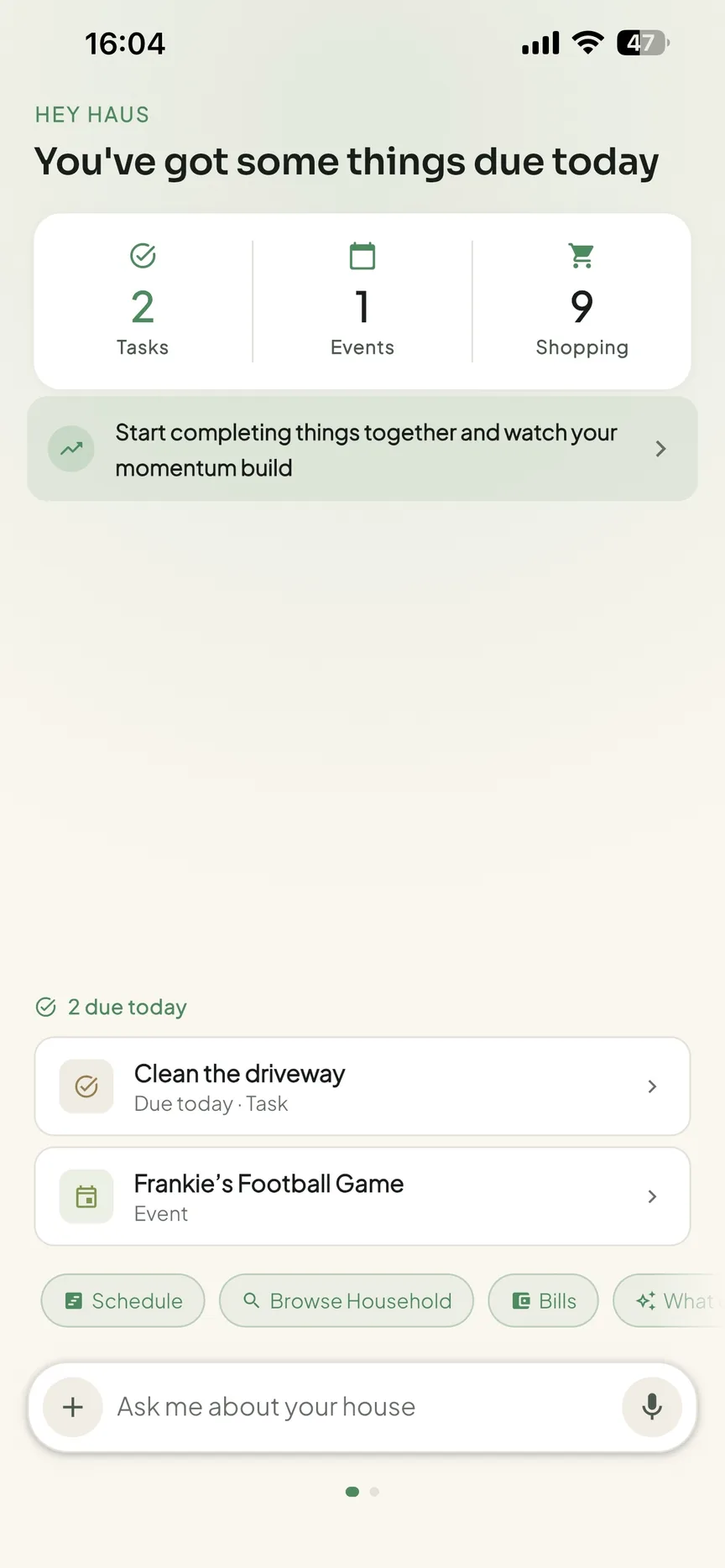
Strengths: automatic rotation, clear ownership, a genuinely shared view, and chores in the same place as the calendar and lists. Calendar syncs with Apple and Google. Privacy-first and ad-free.
Limits: it is a whole-home app, not a dedicated deep-cleaning tracker, so if all you want is room-by-room cleaning scores, a cleaning specialist may feel more focused.
Platforms: iPhone, iPad, Apple Watch and Android, plus connected AI assistants.
Pricing: free to download, with a 30-day trial and then a single household subscription that covers both of you (OneHaus, checked August 2026).
Best for: couples and shared households that want chores split fairly through rotation, inside a wider home app.
Sweepy
Sweepy is a cleaning specialist that turns upkeep into something visual. Instead of a flat task list, it tracks how clean each room is and surfaces what needs attention next, using effort levels and a smart schedule that fits your availability. You can add your partner so the workload is shared and tracked, which takes some of the heat out of the "who did more" argument because the app, not one person's standards, decides when something is due.
Strengths: removes debate about whether a room actually needs cleaning, tracks each person's contribution over time, large library of suggested tasks.
Limits: it is cleaning only, so no calendar, shopping or general task management. Sharing tasks with a partner needs the premium tier, and it nudges new chores rather than running a strict person-to-person rotation.
Platforms: iOS and Android.
Pricing: free to download with a premium upgrade, around $3.99/month or $19.99/year with a 3-day trial (Sweepy on the App Store, checked August 2026; confirm current pricing in your region).
Best for: couples whose main friction is cleaning consistency and standards rather than overall organisation. See OneHaus vs Sweepy for a full breakdown.
Tody
Tody is the other strong cleaning specialist. It organises your home into zones and schedules cleaning by how long it has been since each task was last done, so the schedule adapts to your actual habits rather than telling you to mop every Tuesday whether it needs it or not. Family sharing lets two people sync, take assignments and use an automated rotation scheme for cleaning tasks.
Strengths: adaptive, need-based scheduling, zone-based layout that matches how people think about their homes, no forced notifications, very highly rated.
Limits: like Sweepy it is cleaning only, with no calendar or lists. There is no dedicated web app, and device-to-device sync sits behind the paid tier.
Platforms: iOS and Android.
Pricing: free to download with a 30-day premium trial, then a Premium subscription (from $9.99/year for a single home) or Premium+ for multi-person sync and sharing (from $25/year for two members) (Tody pricing, checked September 2026).
Best for: couples who want adaptive, room-by-room cleaning with light built-in rotation for the cleaning side. See OneHaus vs Tody for a full comparison.
Flatastic
Flatastic is built for shared living, and it leans into the money side as much as the chore side. It combines a cleaning rota, a shared shopping list, a task manager and shared expense tracking, so flatmates can see whose turn it is to clean and who owes what for the bills. Chores use reminders and a points system, and there is a pinboard for house messages.
Strengths: strong fit for flat-shares that pool money, expense tracking and bill splitting alongside chores, useful house-communication tools.
Limits: the free version has been criticised for frequent ads, including after ticking off tasks. The points framing leans more towards tracking contribution than enforcing a strict rotation, and it is less suited to couples who do not need expense splitting.
Platforms: iOS and Android.
Pricing: free with ads, with Flatastic Premium (ad-free, expense export, receipt images) around 1.99 euro/month or 17.99 euro/year in euro-priced regions (Flatastic on Google Play, checked August 2026; confirm current pricing in your region).
Best for: flatmates and roommates who split bills and groceries as well as chores.
Cozi
Cozi is a broad organiser built around a shared calendar, shopping lists and to-do lists, with chore lists added in a recent update. For a couple who already run their lives off one shared calendar, it keeps light chore tracking in the same place as appointments and the weekly shop. It is reliable and widely used.
Strengths: mature shared calendar, shopping and lists in one place, good if your household already lives in the calendar.
Limits: chores are functional rather than specialised, with no automatic person-to-person rotation, so keeping the split fair still depends on you reassigning tasks. The free tier became more limited in 2024, pushing month view and other features into paid tiers, and it is ad-supported unless you pay.
Platforms: iOS, Android and web.
Pricing: free with ads; Cozi Gold is around $39/year for the ad-free, premium experience, with a higher Cozi Max tier above it (Cozi Gold, checked August 2026).
Best for: calendar-first couples who want light chore tracking next to everything else.
A note on kid-reward apps
Apps like OurHome and S'moresUp come up constantly in chore-app lists, and they are good at what they do, but they are built for parents motivating children with points, currencies and rewards. For two adults that machinery is dead weight: you do not need to bank points or claim a reward to do your share. If there are no kids in the equation, skip them and choose for rotation, visibility and balance instead.
How do the best chore apps for couples compare?
Criteria below: how chores are shared, whether the app suits adults, its cleaning focus, expense splitting, wider tools, AI input, platforms and pricing (checked August 2026).
| App | Automatic rotation | Built for adults | Cleaning-routine focus | Expense / bill splitting | Wider household tools | Assisted input | Platforms | Pricing |
|---|---|---|---|---|---|---|---|---|
| OneHaus | Yes, for any chore | Yes | General tasks | No | Calendar, shopping, recipes, inventory | Yes, via MCP assistants | iPhone, iPad, Apple Watch, Android | 30-day trial, then one paid household sub |
| Sweepy | Auto-suggested tasks | Yes | Yes, specialist | No | Cleaning only | No | iOS, Android | Free + paid |
| Tody | Yes, cleaning tasks | Yes | Yes, specialist | No | Cleaning only | No | iOS, Android | One-time + paid sync |
| Flatastic | Rota with points | Yes | General tasks | Yes | Shopping, expenses | No | iOS, Android | Free + paid |
| Cozi | No | Yes | Basic lists | No | Calendar, shopping | No | iOS, Android, web | Free + Gold |
How do you choose a chore app as a couple?
Start with the problem you are actually trying to fix, because the apps split cleanly by it.
If the real issue is that the same person keeps ending up with the same jobs, you want rotation, and OneHaus is built around it, with chores cycling automatically and living alongside your calendar, shopping and inventory. If the friction is purely about cleaning standards, a specialist like Sweepy or Tody keeps the home consistently clean and takes the personal judgement out of when a room is due. If you share a flat and the arguments are as much about money as mess, Flatastic handles expenses and groceries beside the chores. And if you already run your relationship off one shared calendar and just want light chore tracking next to it, Cozi keeps it all together.
The one thing to avoid is reaching for a kids' reward app to solve an adults' fairness problem. Points and stars do not make a split fair, rotation and visibility do.
Frequently asked questions
What is the best chore app for couples?
For couples the feature that matters most is fair division, not rewards. The best pick is one that rotates recurring chores automatically so the same jobs do not always fall to the same person, gives you a shared view of who owns what, and shows the split staying even over time. OneHaus is built around automatic rotation, while Sweepy and Tody are strong if your friction is specifically about cleaning standards. Kid-focused reward apps tend to be a poor fit for two adults.
How do couples split chores fairly?
Start by listing every recurring job, including the invisible ones like noticing supplies run low or booking maintenance, then share them out rather than letting them default to whoever notices first. The most sustainable approach is rotation, so nobody is permanently stuck with the worst tasks, plus a shared view so both of you can see the current split. A free chore fairness calculator can show how even your current division actually is before you change anything.
What is chore rotation and why does it matter?
Chore rotation means recurring tasks cycle automatically between you, so this week's bins are the other person's job next week. It matters because it removes the silent assumption that one person always handles the same jobs, which is one of the most common sources of resentment in shared homes. Without rotation, keeping things "fair" depends on someone remembering to reassign tasks, and that remembering is itself part of the mental load.
What is the mental load and can an app help?
The mental load is the invisible work of running a home: remembering, planning, noticing and coordinating, rather than the visible doing. It often falls disproportionately on one partner and rarely shows up on a basic chore chart. An app helps when it makes that work visible and shared, by giving recurring tasks clear ownership, rotating them automatically, and keeping them next to the calendar and lists so nothing has to live only in one person's head.
Are chore apps for roommates different from ones for couples?
The core need is the same, fair division and visibility between adults, so rotation and a shared view help both. The main difference is money: roommates and flat-shares often also split bills and groceries, which is where an app like Flatastic earns its place. Couples who do not pool expenses separately usually get more from an app that focuses on rotation and the wider home, like OneHaus.
What devices do these apps run on, and does OneHaus have an Android app?
Sweepy, Tody, Flatastic and Cozi all run on iOS and Android, and Cozi also has a web app. OneHaus has native apps for iPhone, iPad, Apple Watch and Android, and connects to AI assistants via MCP, so whether one of you is on iPhone and the other on Android, you each get the native app and share the same household. OneHaus is not available as a web app.
Which chore app should couples choose?
For couples and shared adult households, the question is not how to motivate someone with points, it is how to share the work fairly and make the invisible part visible. Cleaning specialists like Sweepy and Tody are great if your only sticking point is standards, Flatastic suits flatmates who split bills, and Cozi works for calendar-first couples. But if the real problem is that the same jobs keep landing on the same person, rotation is the feature to look for, and OneHaus is built around it, with chores cycling automatically next to your shared calendar, shopping, recipes and home inventory. Start with the 30-day trial, invite your partner, add five recurring jobs, and check after two weeks whether the jobs have stopped defaulting to one person.
See how it works for two-adult homes on the OneHaus for couples page, check your current split with the free chore fairness calculator, or read OneHaus vs Sweepy and OneHaus vs Tody for the head-to-heads.
Try OneHaus on iPhone, iPad, Apple Watch or Android.