The Mental Load Checklist: Invisible Labour at Home
A grouped checklist of the invisible mental-load tasks in a household, from meals to admin, plus who usually carries them and how to share the load fairly.
Family OrganisationThe mental load is the invisible work of remembering, noticing, planning and coordinating that keeps a home running, and it almost always sits with one person. The fix is to make it visible and then share whole jobs, not single tasks, so use the checklist below to name every invisible job first, then hand ownership over.
This is the concrete checklist. If you want the method behind it, the step-by-step guide to reducing and sharing the mental load covers how to actually move the work off one person's plate. This post gives you the raw list to work from: the specific invisible tasks, grouped by area, so nothing hides. Print it, screenshot it, or copy it into a shared note, because once one person's silent to-do list is on paper, it stops being invisible and becomes something a household can split.
What is on a mental load checklist?
A mental load checklist is a list of the planning, remembering and noticing jobs behind visible chores, grouped by area of the home. It does not list "do the washing up". It lists the invisible work around it: knowing the dishwasher tablets are low, noticing the school shoes no longer fit, remembering that the car tax is due next month.
Below, the invisible tasks are grouped into six areas. Tick the ones one person is currently carrying alone. Most households find the list is far longer, and far more lopsided, than either partner expected.
Meals and food
- Deciding what the household eats this week.
- Checking what is already in before shopping.
- Noticing when staples (milk, bread, coffee, nappies) are running low.
- Remembering who is fussy about what, and any allergies.
- Keeping track of use-by dates so food is not wasted.
- Planning around who is in or out on which night.
Cleaning and laundry
- Noticing when a room has tipped over into needing a proper clean.
- Knowing when the bins and recycling go out, and which is which week.
- Tracking whose turn it is for the shared jobs.
- Remembering the occasional tasks: oven, windows, filters, descaling.
- Keeping on top of laundry so nobody runs out of what they need.
- Restocking the cleaning supplies before they run out.
Kids and school
- Knowing which child needs which kit on which day.
- Remembering non-uniform days, trips, payments and permission slips.
- Booking and tracking medical, dental and optician appointments.
- Keeping on top of homework, reading records and reply slips.
- Organising childcare, clubs, playdates and pickups.
- Buying the next size up before the shoes actually stop fitting.
Finances and admin
- Knowing when bills, renewals and direct debits are due.
- Tracking car tax, insurance, MOT and servicing dates.
- Remembering to cancel free trials before they charge.
- Keeping warranties, documents and passwords findable.
- Watching the budget and flagging when something is off.
- Chasing refunds, forms and the admin nobody wants.
Social and calendar
- Remembering birthdays and sorting cards and presents.
- Keeping the family calendar in one person's head.
- RSVPing, coordinating diaries and avoiding clashes.
- Staying in touch with both sides of the family.
- Planning holidays, days out and celebrations.
- Being the one who knows what everyone is doing this weekend.
Home and maintenance
- Noticing the small repairs before they become big ones.
- Tracking when appliances are under warranty or due a service.
- Remembering seasonal jobs: boiler check, gutters, garden, smoke alarms.
- Keeping on top of pet care: food, flea treatment, vaccinations, vet visits.
- Restocking the everyday supplies nobody thinks about until they run out.
- Knowing who to call when something breaks.
The invisible labour checklist at a glance
The same list, as a table, makes the pattern obvious. For each area, here is a typical invisible task and who research suggests most often carries it. A 2024 study from the University of Bath of 3,000 parents found mothers handle 71% of household mental-load tasks against 45% for fathers, so in many homes one person carries most of the column below.
| Area | Example invisible task | Who typically carries it |
|---|---|---|
| Meals and food | Planning the week and noticing what is running low | Usually one person, most often the mother |
| Cleaning and laundry | Tracking whose turn it is and when jobs are due | Usually shared unevenly, weighted to one person |
| Kids and school | Remembering kit, trips, payments and appointments | Overwhelmingly the primary parent |
| Finances and admin | Knowing when renewals and bills fall due | Often split by category but rarely evenly |
| Social and calendar | Holding the family calendar and remembering birthdays | Most often one person, frequently the mother |
| Home and maintenance | Spotting repairs and tracking warranties and services | Varies, sometimes the more visible split |
The "who" column is a generalisation, not a verdict on your home. The value of the exercise is filling it in honestly for your own household, because the surprise is usually how much sits in one column.
How do you share the mental load of motherhood list?
You share it by handing over whole jobs, not single tasks. "Can you put a wash on" leaves you as the manager who noticed, planned and will chase it. "You own the laundry" moves the noticing and remembering off your plate for good. That distinction is the heart of the how-to guide, so here is just the short version to act on the checklist above.
Work through your ticked list together and assign whole areas. One person owns the food shop and what the household eats. One person owns the kids' school admin, end to end. Owning a job means knowing when it needs doing, deciding how, doing it, and restocking or following up so it does not bounce back. Then resist taking it back the moment it is not done your way, because a job that lives in someone else's head is worth more than one done to your exact standard but still managed by you.
Two things make the split stick. First, agree it out loud and write down who owns what, so there is no ambiguity to argue about later. Second, put the recurring jobs somewhere they resurface on their own, so remembering when things are due stops being a job at all. A cleaning rota that splits chores fairly is a good place to start with the household jobs specifically.
Making the checklist visible with OneHaus
A list on paper is a great start, but it lives in a drawer. To keep the mental load shared, the household needs a single place everyone can see, and that is where a shared app earns its place. OneHaus is built to make invisible work visible.
Put the ticked tasks in as shared tasks and chores, and the ones that repeat can go on an automatic rotation, so ownership moves fairly between household members each time a job comes round and the "whose turn is it" argument disappears. The AI assistant means capture is a single plain sentence, typed or spoken, like "remind me to book the dog's booster next week", so a half-formed thought leaves your head the moment it lands. Shared shopping lists sort themselves by aisle and update for everyone, and the home inventory holds the warranties, appliances, documents and renewal dates that otherwise live in one person's memory.
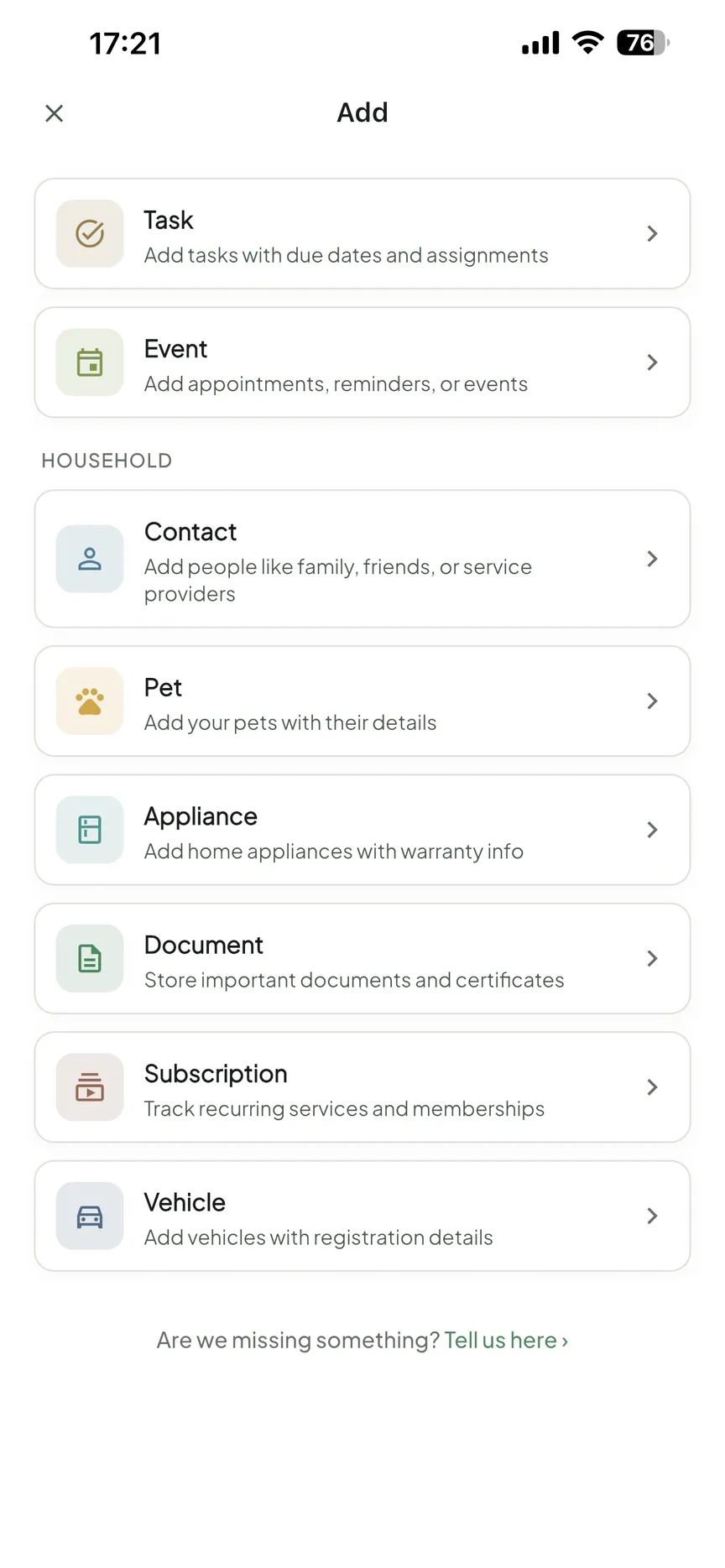
The checklist then stops being one person's private list and becomes something the whole household can open and read. OneHaus is available on iPhone, iPad, Apple Watch and Android, plus connected AI assistants such as ChatGPT and Claude. It is not a magic fix for an unfair split, that still takes an honest conversation, but it removes the two jobs that make sharing hard: remembering when things are due, and keeping the whole load in view.
If your household runs on a brain that works differently, the guide to household management with ADHD covers systems that hold the remembering for you. And to turn the checklist into a running routine, the daily planner for busy households shows how to keep it moving day to day.
Frequently asked questions
What is on a mental load checklist?
A mental load checklist lists the invisible planning, remembering and noticing jobs behind visible chores, grouped by area of the home. It covers meals, cleaning and laundry, kids and school, finances and admin, social and calendar, and home maintenance, naming the mental work rather than the chores themselves so it can be seen and shared.
What is the mental load?
The mental load is the cognitive work of running a home: remembering deadlines, noticing what needs doing before it becomes a problem, and coordinating everyone. It is separate from the visible chores, and it usually falls on one person because no one else can see it.
How do you share the mental load fairly?
Write down every invisible task first so the scale is visible, then hand over whole jobs rather than single instructions. Owning a job means knowing when it needs doing, deciding how, doing it and following up, so it leaves your head entirely. Putting recurring jobs on an automatic rotation keeps the split fair without renegotiating it every week.
What is invisible labour in a household?
Invisible labour is the unseen mental and organisational work that keeps a home running, such as tracking appointments, noticing supplies running low and remembering renewal dates. It is called invisible because it produces no finished object, so it is easy to overlook and hard to split unless it is written down.
What is the best app for tracking the mental load?
OneHaus is built specifically to make invisible household work visible and shareable, with shared tasks, automatic chore rotation, an AI assistant for quick capture, shared shopping lists and a home inventory. It is available on iPhone, iPad, Apple Watch and Android, plus connected AI assistants, so the whole household can see and share the load rather than leaving it in one person's head.
How is a mental load checklist different from a chore list?
A chore list names the visible tasks, like "hoover the stairs". A mental load checklist names the invisible work around them: noticing they need doing, remembering when, and keeping the household on track. Splitting a chore list still leaves one person managing everything, which is why the mental load needs its own list.
Try OneHaus
Make the invisible work visible for your whole household. Download OneHaus to turn your checklist into shared tasks, put recurring chores on an automatic rotation, and capture new things in a single sentence. Free to download with a 30-day free trial, then one subscription covers everyone who lives together, on iPhone, iPad, Apple Watch and Android.