Daily Planner for Busy Households: Plan the Day Together
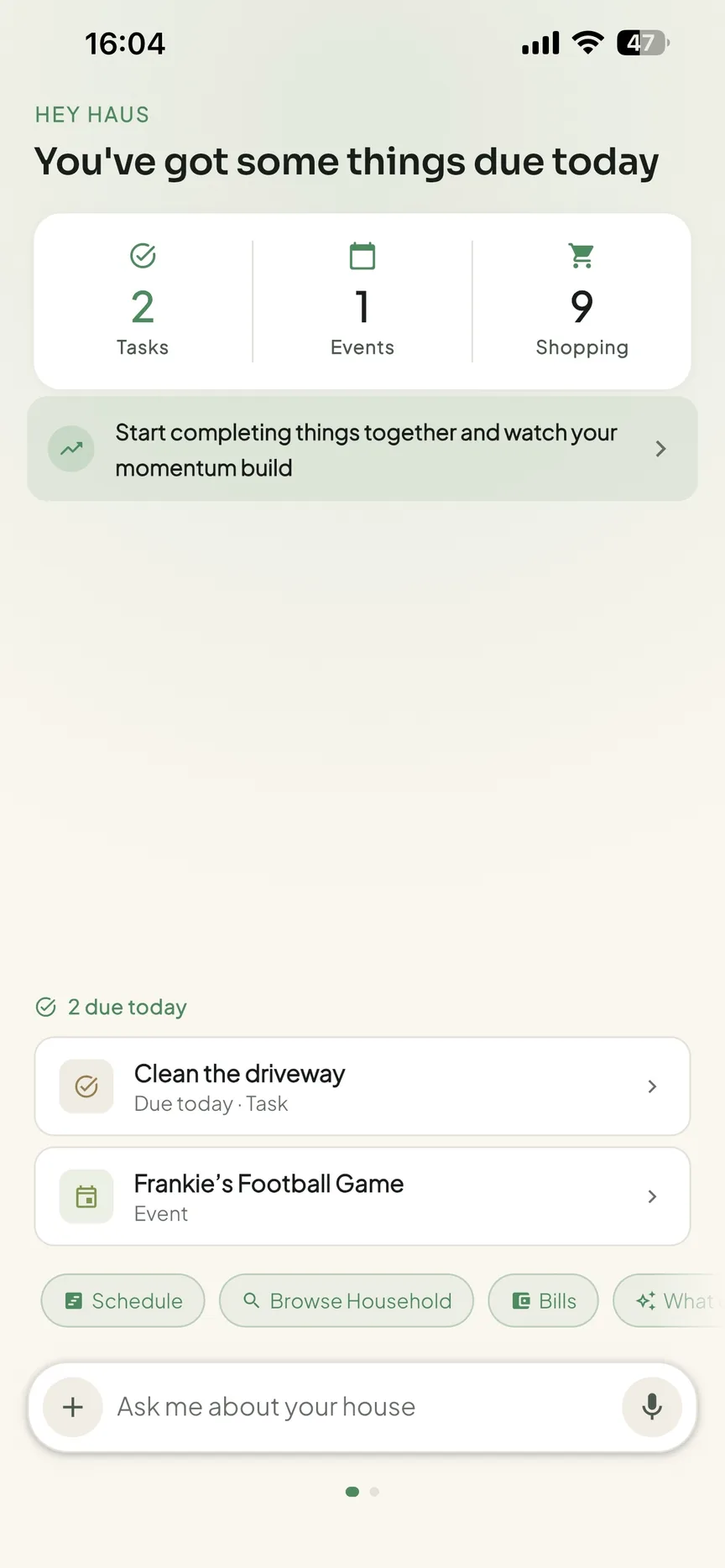
A daily planner for busy households keeps tasks, events and the shopping list in one shared view, so the day is shared and nothing lands on one person.
Productivity & PlanningA daily planner for a busy household is not a personal to-do list. It is a shared view of the day that everyone can see: what is on, who is doing what, and what needs picking up on the way home. When the plan lives in one place, the running of the home stops falling to whoever happens to be holding it in their head.
Most "daily planners" you find are beautiful paper diaries and printable templates. Those are great for one person planning one life. They fall apart the moment two or more people share a home, because a paper page only ever sits in front of whoever is holding it. This guide is about the other kind of planning: the shared, household kind, where the school run, the dentist appointment and the milk that ran out this morning all live somewhere everyone can see them.
What a shared daily plan needs
- Today, at a glance. Tasks and events for the day laid out together, not split across three apps and a sticky note on the fridge. A busy household lives or dies on whether anyone can answer "what is happening today?" in five seconds. If the answer takes a phone call or a scroll through four calendars, the plan is already failing.
- Shared, not solo. Everyone in the home sees the same plan and can add to it. Anyone can drop in the thing they just remembered, so the plan stays current without a single coordinator carrying it.
- Tasks that recur. The repeating jobs (bins, swimming kit, the weekly shop, paying the childminder) show up on the right day without anyone re-entering them. Most of household life is the same handful of tasks on a loop. A good planner sets them once and forgets them, so your attention is free for the things that actually change.
- The shopping list, attached. Errands and the weekly shop sit beside the plan, so nothing is forgotten on the way home. The "can you grab milk?" text is a symptom of a list that lives in one person's head. When the list is part of the same shared view as the day, whoever passes the shop already knows what to pick up.
- Reminders that nudge the right person. A plan no one looks at is just a nicely arranged list of things you will forget. The day before a busy evening, the morning of a clashing appointment: the plan should tap the right shoulder at the right time.
How to plan your day as a household
The best household plan is a habit, not a project. You do not need a Sunday-afternoon ritual with coloured pens (though you can have one). You need a short, repeatable look at the day that you actually keep up. Five minutes the evening before, or over the first coffee in the morning, is plenty. Run it the same way each time:
- Look at the day together. Open the one shared view and read down it. The goal is simply that more than one person knows what today holds. Even a thirty-second skim out loud at breakfast stops the "wait, that's today?" panic.
- Capture the fixed events. Anything with a time attached goes in first: work, school, appointments, clubs, the parcel delivery slot. These are the immovable walls of the day, and everything else has to fit around them.
- Add the must-dos. The handful of tasks that genuinely have to happen today. Not the whole wishlist. Three or four things that, if they slip, cause a problem tomorrow. Be honest about the difference between "would be nice" and "must".
- Assign who does what. Every event and every must-do gets a name. Not "someone", a name. The school pickup, the prescription collection, the email to the plumber. Half of household stress is two people each assuming the other has it.
- Note what needs buying or collecting. Run the day once more for errands: a card for the party, the dry cleaning, the thing that needs returning. Drop them on the shared list so whoever is out and about can grab them without a separate reminder.
That is the whole method. It works because it is short enough to do daily and shared enough that the plan does not live or die with one person.
An example daily plan for a busy household
Here is what a realistic weekday looks like for a household with two working adults and two children at school. Copy the shape of it and swap in your own names and timings.
| Time | What is on | Who is responsible | Errands and collections |
|---|---|---|---|
| 7:00am | Breakfast, uniforms, packed lunches | Alex (lunches), Sam (uniforms) | Defrost mince for tonight |
| 8:15am | School run | Sam drops both kids | Post the birthday card on the way |
| 9:00am | Both adults at work | - | - |
| 12:30pm | Dentist (Jamie) | Alex takes a long lunch | Collect prescription next door |
| 3:15pm | School pickup | Childminder collects | - |
| 4:00pm | Football training (Mia) | Sam drives, kit washed last night | Pick up shin pads from the hall |
| 5:30pm | Homework and downtime | Childminder until 6 | - |
| 6:00pm | Dinner | Alex cooks | Grab bread and milk on the way home |
| 7:30pm | Bath and bedtime | Sam | - |
| 8:30pm | Bins out (recycling week) | Whoever is up | Plan tomorrow, five minutes |
Notice how the plan does two jobs at once. It says what is happening, and it says who owns it. The errands column is the quiet hero: it means nobody has to remember the bread, the shin pads or the birthday card on top of everything else. They are written down, attached to the moment they fit into the day.
Time-blocking for a busy family
Time-blocking sounds like a productivity-influencer thing, but for a household it is just common sense: group the day into a few broad blocks instead of a frantic minute-by-minute schedule. Most family days fall naturally into three or four:
- The morning block (wake-up to drop-off): breakfast, getting dressed, packed lunches, out the door. This block is almost always the most stressful, because everything in it has a hard deadline. Protect it by prepping the night before (lunches made, bags packed, uniforms out) so the morning is execution, not decision-making.
- The day block (work and school): largely fixed by other people's timetables. Your job here is mostly to slot in appointments and errands that have to happen in daylight hours.
- The after-school block (pickup to dinner): clubs, homework, the witching hour before tea. This is where clashes hide, so it is worth blocking out who is collecting whom and who is cooking well in advance.
- The evening block (dinner to bedtime): dinner, baths, the bedtime routine, the daily tidy, and the five-minute look at tomorrow.
The two blocks worth fiercely protecting are the school run and dinner time. Try not to let work calls, appointments or errands bleed into them. When those two anchors hold, the rest of the day flexes around them without the whole thing collapsing. A block does not need precise timings; it needs a clear owner and a protected edge.
Personal planner vs a shared household planner
A personal planner organises one person's life. It is brilliant for that. The trouble is that a household is not one person's life, and the moment you try to run a shared home from a personal planner, all the coordination falls to whoever owns the planner.
That is how the mental load forms. One person becomes the keeper of the schedule: the only one who knows that Tuesday is swimming, that the dentist moved to Thursday, that the car tax is due. Everyone else has to ask them, which makes them the bottleneck for the entire home. They cannot switch off, because the plan only exists in their planner and their head.
A shared household planner fixes this by making the plan a thing everyone can see and edit, rather than a thing one person maintains. When your partner can see the day, they do not need to ask. When a teenager can see their own jobs, they do not need reminding (as much). The planning stops living in one person's head and becomes something the household genuinely shares.
This hidden coordination work has a name, and the research on it is sobering. A systematic review of cognitive household labour found that the planning, anticipating and remembering that runs a home falls disproportionately on one person, and that carrying it is linked to real emotional strain. The gap is large, too: separate University of Bath research published in 2025 found mothers report 67% more household management, the scheduling and food planning especially, than fathers, and that a higher income does not shrink that mental load. One thing that comes up often when people tell us how they use OneHaus: the day usually exists in one person's head, and they cannot switch off because no one else can see it. A shared planner is the most direct way to spread that load, because it turns the plan into something everyone can read instead of something one person has to hold.
Paper vs digital daily planner
Paper planners are lovely, and for some people they will always win. Writing the day out by hand is calming, it never runs out of battery, and there is real satisfaction in crossing things off. If you live alone or you simply think better on paper, do not let anyone talk you out of it.
But be honest about the trade-offs for a busy, shared home:
- Sharing. A paper planner sits in one place with one person. A digital one is on everyone's phone at once. For a household, this is the whole ballgame.
- Recurring jobs. Paper means rewriting "bins" and "swimming" every single week, forever. Digital sets them once and they reappear on the right day on their own.
- Reminders. Paper cannot tap you on the shoulder. A digital planner can nudge the right person the night before a busy evening, which is exactly when a nudge is worth most.
- Changes. Plans move constantly in a busy home. Crossing out and rewriting a paper page gets messy fast; a digital plan updates cleanly and everyone sees the new version.
The honest conclusion: for a single person who likes the ritual, paper is a fine choice. For a household that shares the load, has lots of recurring jobs and needs reminders, digital wins comfortably. The goal is not a beautiful page. It is that nobody has to carry the whole day alone.
How OneHaus fits
OneHaus lays out tasks and events day by day for the whole household, with recurring chores, a shared calendar and shared shopping lists in the same app. Tell it what needs doing in a sentence and it lands on the right day, for the right person. Recurring jobs set themselves once and reappear on schedule, reminders nudge the night before a busy evening, and the shopping lists sit beside the plan so the errands never get forgotten. Because everyone in the home sees the same view, the plan stops depending on whoever remembers it.
It can also import outside dates straight into the shared plan: national and religious holidays for your country, plus any calendar published as an ICS or webcal link such as school term dates, sports fixtures or bin collection days. See how to add holidays and calendar feeds for the walk-through.
OneHaus is on iPhone, iPad, Apple Watch and Android. Every household starts with a free 30-day trial, and one subscription covers everyone you invite.
See how it works on the OneHaus for shared households page, or start a free trial.
Frequently asked questions
What is a daily planner?
A daily planner is a single place to lay out everything happening on a given day: the timed events, the tasks that need doing, and who is responsible for each. For one person that can be a paper diary or an app. For a household, the useful version is shared, so everyone can see the same day and add to it, rather than one person keeping the plan in their head and relaying it to everyone else.
How do I plan a busy family day?
Take five minutes the evening before or over morning coffee. Look at the day together, drop in the fixed events first (work, school, appointments, clubs), add the three or four tasks that genuinely must happen, put a name against each one so nothing is left to "someone", and note anything that needs buying or collecting on the way home. Keep it short enough to do every day. The consistency matters more than the detail.
Should I use a paper planner or an app?
If you live alone and enjoy the ritual of writing, paper is a great choice. For a busy shared household, a digital planner usually wins, because it is on everyone's phone at once, sets recurring jobs automatically, sends reminders the right person actually sees, and updates cleanly when plans change. The deciding factor is whether the plan needs to be shared and to nudge people. If it does, go digital.
How do I get the whole family to actually use it?
Make it the single source of truth and keep it visible. Put everything in it, so checking the planner becomes the habit rather than asking around. Attach names to jobs so each person has clear, visible responsibilities instead of vague nagging. Give kids their own tasks they can tick off. And run a quick daily look at it together, so reading the plan becomes part of the family rhythm rather than one more thing to remember.
Related guides
- Organising your home: a calm, room-by-room guide: the full playbook for quick wins, room-by-room systems, and the habits that make it stick.
- The Sunday Reset Routine: a short weekly reset that sets up the whole week's daily plans.
- How to Set a Reminder That Actually Works: get nudged at the right time so the plan does the remembering for you.
- Add holidays and calendar feeds to your shared home: pull holidays, school terms and bin days into the shared plan automatically.
- Time blocking: give every task a slot in the day: turn the daily plan into a timed schedule so you always know what is next.
- Christmas planning checklist: a calm holiday countdown: plan the busiest season one calm step at a time.