How to Keep on Top of Home Maintenance (2026 Guide)
A simple system to track home maintenance so appliances, warranties, vehicles and seasonal jobs are logged, turned into reminders, and never forgotten.
Home & InventoryThe reason most home maintenance gets forgotten is simple. It lives in nobody's system. The boiler service, the appliance warranty, the gutters that need clearing before autumn, none of them has a fixed home, so each one survives only as long as someone happens to remember it. The fix is just as simple. Log what you own, record the dates that matter, turn those dates into reminders someone actually acts on, and share the work so it is not one person carrying all of it in their head.
This guide walks through that system step by step: a seasonal checklist to cover the recurring jobs, a way to log appliances and vehicles with their service and warranty dates, how to turn those dates into recurring reminders, and how to share the whole thing so the load is spread fairly. You can build the lot in an afternoon and then mostly leave it running.
Why home maintenance slips through the cracks
A house generates a steady stream of small obligations. Filters need changing, smoke alarms need testing, the heating wants a service before winter, a warranty quietly runs out, a car has its MOT due. None of these is hard on its own. The problem is that they arrive at different times, from different sources, and there is rarely one place they all land.
So they scatter. The warranty card goes in a kitchen drawer, the service reminder sits unread in an email account, the seasonal jobs exist only as a vague sense that "we should really do the gutters at some point". When something fails, the cost is higher than it needed to be and the warranty turns out to have expired two weeks ago. It adds up: Bankrate's Hidden Costs of Homeownership study found home maintenance is now the single largest hidden cost of owning a home, at $8,808 a year on average, and much of that bill is the unplanned kind that a missed service turns into.
Keeping on top of home maintenance is not about doing more work. It is about making sure the work that matters is written down somewhere reliable, attached to a date, and pointed at a person. Everything below is built around that idea.
Start with a seasonal checklist
The easiest way to cover recurring jobs is to think in seasons rather than trying to remember individual dates. Most home maintenance falls naturally into four buckets, and working a season at a time keeps the list from feeling endless.
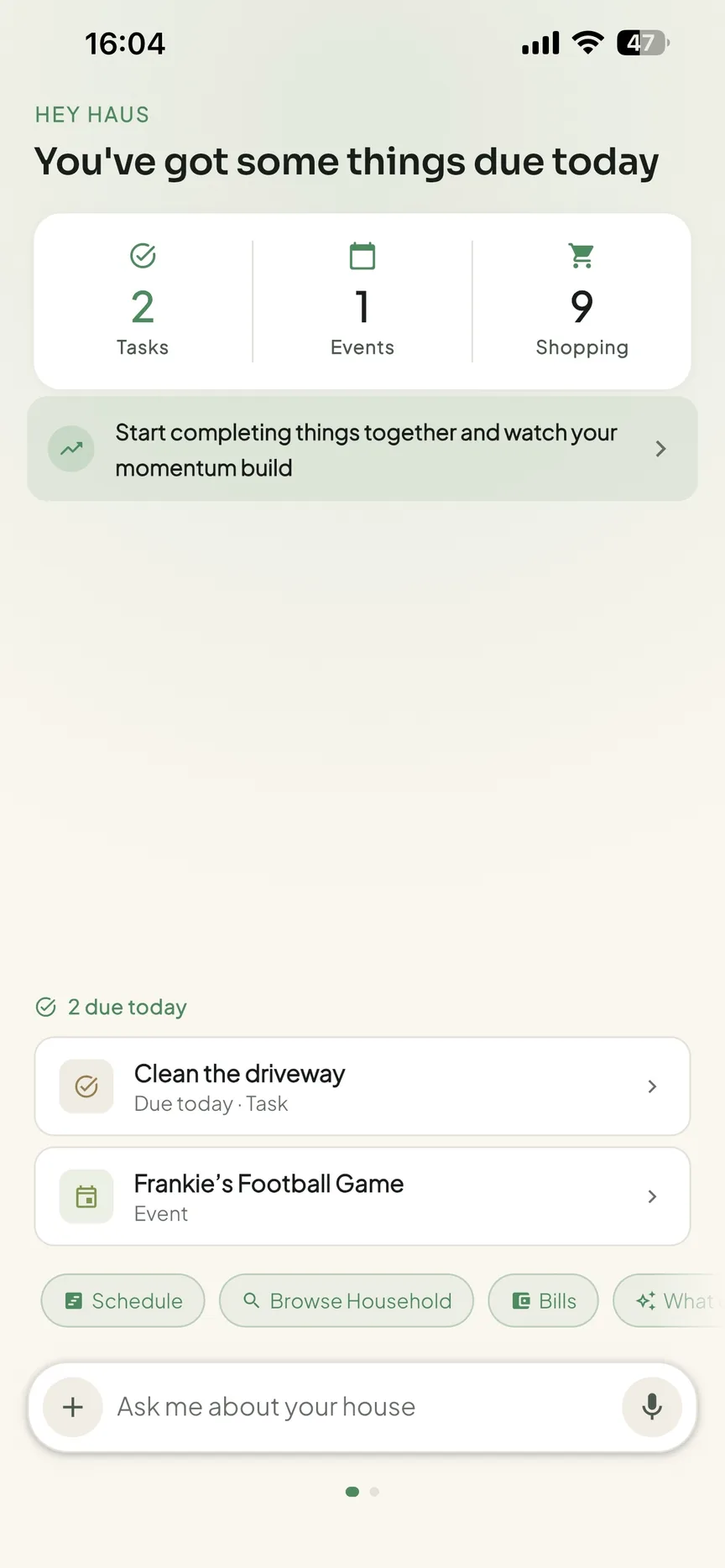
Spring
- Clear gutters and downpipes after winter debris builds up.
- Check the roof and chimney for loose tiles or damage from winter storms.
- Service the boiler or heating system while demand is low and engineers are easier to book. British Gas recommends an annual service to keep the boiler safe and the warranty valid.
- Test the garden tap and outdoor sockets after the cold months.
- Deep clean behind and under large appliances.
Summer
- Re-seal or treat decking, fences and outdoor woodwork while it is dry.
- Check window and door seals for draughts before next winter.
- Service or clean air conditioning and fans if you have them.
- Inspect the loft for damp, pests or insulation gaps.
- Bleed radiators so they are ready for autumn.
Autumn
- Clear gutters again before the leaves and rain arrive.
- Service the heating before the first cold snap puts every engineer on a waiting list.
- Check and reset the timer on the central heating.
- Drain or insulate outdoor pipes against frost.
- Sweep the chimney if you use a fire or wood burner.
Winter
- Test smoke and carbon monoxide alarms and replace batteries. UK fire services advise testing alarms monthly, so a recurring monthly reminder is the safest cadence.
- Keep an eye on pipes during cold spells to catch freezes early.
- Check loft insulation is doing its job once the heating is running hard.
- Clear paths and drains of ice and blockages.
- Note anything that struggles in the cold, such as a weak car battery, so it is on the list for spring.
You do not have to action every item the moment the season turns. The point of the checklist is that nothing has to be remembered from scratch. Each season simply hands you a short, predictable list of jobs.
Log what you own, with the dates that matter
Seasonal jobs cover the recurring chores. The other half of home maintenance is the things you own that carry their own deadlines: appliances under warranty, the car with its MOT and service, important documents that expire. These slip because the date lives on a sticker, a certificate or in somebody's memory rather than anywhere you would think to look.
The fix is a simple home inventory. You do not need to log every item in the house. Record the things that have a date attached or details you would need in a hurry:
- Appliances such as the boiler, washing machine, dishwasher and fridge, with brand, model, serial number and the warranty expiry date. The serial number usually hides on a sticker inside a door or around a rim, so capturing it once saves you crouching on the floor later.
- Vehicles with MOT, tax, insurance and next service dates. A car carries more recurring deadlines than almost anything else in a household.
- Pets with vaccination and booster dates, microchip numbers and vet details.
- Warranties and important documents such as insurance policies and passports, with their renewal or expiry dates.
When we built these categories, the one that surprised us was vehicles. We expected appliances to be the headline use, but in practice a single car carries four or five separate recurring dates (MOT, tax, insurance, service, sometimes a warranty) more than most boilers or fridges, which is why we gave it its own record type rather than treating it as one more "appliance". The other thing we learned early: people abandon an inventory the moment it asks for too much. That is why each entry only insists on a name and the date that matters, with serial numbers and model details optional, because a half-filled record that actually reminds you beats a perfect one nobody finishes.
The job is the same for all of them. Record the details once, note the date that matters, and you have turned a deadline that only existed in someone's memory into something you can act on. OneHaus gives each of these its own place: appliances, vehicles, pets, warranties and important documents, all with expiry and maintenance dates, so the whole inventory sits in one shared record rather than scattered across drawers and inboxes.
If you want a head start, the free Home Maintenance Planner gives you a structured place to capture these dates before you commit them to anything.
Turn dates into reminders someone acts on
A logged date is only useful if it comes back to find you. A warranty expiry written down but never surfaced again is no better than one you forgot. The step that makes the whole system work is turning each date into a reminder that arrives in time to do something about it.
There are two kinds of reminder worth setting up.
One-off reminders for fixed deadlines: a warranty running out, an MOT due, a passport expiring. Set these to land a couple of weeks ahead so you have time to book the work or compare renewal prices rather than scrambling on the day.
Recurring reminders for the jobs that come round on a rhythm: the annual boiler service, monthly alarm tests, the seasonal checklist above. OneHaus handles these as recurring tasks, so once you set "test the smoke alarms" to repeat every month, it keeps coming back on its own without anyone having to remember to re-add it.
The detail that matters most is that a reminder should become a task someone owns, with a name against it, rather than a notification that flashes and disappears. In OneHaus a reminder becomes a shared task the household can see, pick up and tick off, so a due date turns into a clear job instead of a vague alert nobody quite takes responsibility for.
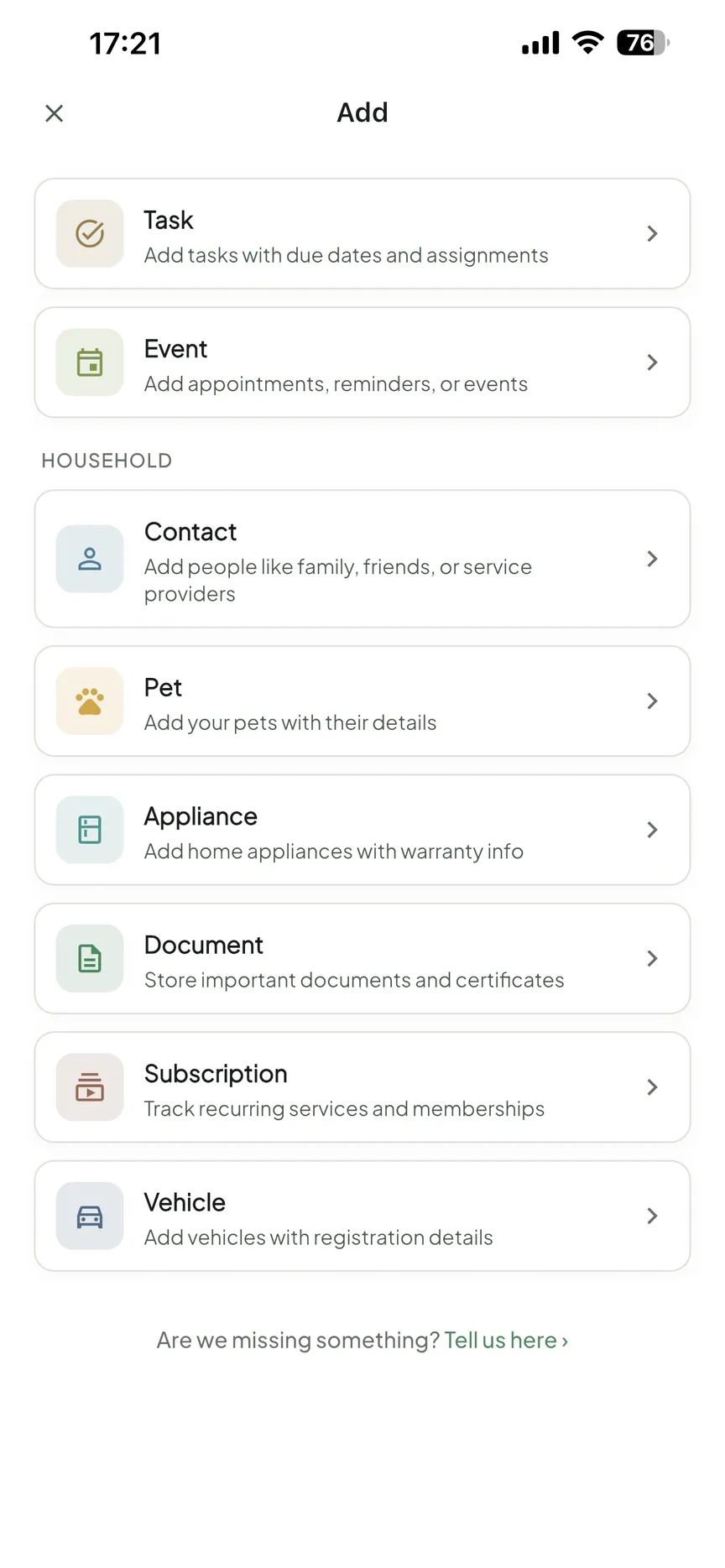
If you would rather not tap through forms, you can capture jobs in plain language. The OneHaus assistant lets you type or say something like "remind me to service the boiler every September" and it sets up the recurring reminder for you. That makes adding a job quick enough that you actually do it in the moment instead of meaning to later.
Share the work so it is not one person's job
Most home maintenance quietly becomes one person's responsibility, usually the person who happens to notice things first. That is how resentment builds and how jobs get dropped when that person is busy or away. A system that lives only in one head is also a system that collapses the moment that head is occupied with something else.
Sharing the work is what makes it sustainable. When the inventory, the reminders and the tasks all live in a shared space, the maintenance stops being one person's mental load and becomes something the household runs together.
A few things make that easier:
- Rotation. OneHaus recurring tasks can rotate between household members, so the boiler service or the quarterly alarm test does not always fall to the same person. Each time the job comes round, it points at whoever is next.
- A shared calendar. Booked jobs, service dates and renewals can sit on a shared calendar everyone can see, so there are no surprises about what is coming up. The OneHaus calendar syncs with Apple Calendar and Google Calendar, so the dates show up alongside everything else a household already tracks rather than living in a separate app nobody opens.
- Shared tasks anyone can pick up. Because reminders become shared tasks, anyone in the household can take one on and mark it done, and everyone can see it has been handled.
When the work is visible and shared, the question stops being "who was supposed to remember this" and becomes "who is free to do it". That is a much easier household to live in. For more on setting this up with a partner or the whole family, see OneHaus for families.
Put it together: a simple system that runs itself
Here is the whole approach in order, so you can set it up in one sitting:
- Work through the seasonal checklist and note the recurring jobs for the season you are in.
- Log your appliances, vehicles, pets and key documents with their warranty, service and expiry dates.
- Turn each date into a reminder, one-off for fixed deadlines and recurring for jobs on a rhythm.
- Make each reminder a shared task so it lands with a person, not just a notification.
- Share the calendar and rotate the recurring jobs so the load is spread across the household.
Once that is in place, the system mostly runs itself. The seasons hand you the recurring jobs, the inventory remembers the dates, the reminders bring them back in time, and the household shares the doing. You stop relying on memory for anything that matters. Start free for 30 days and build your own system this afternoon.
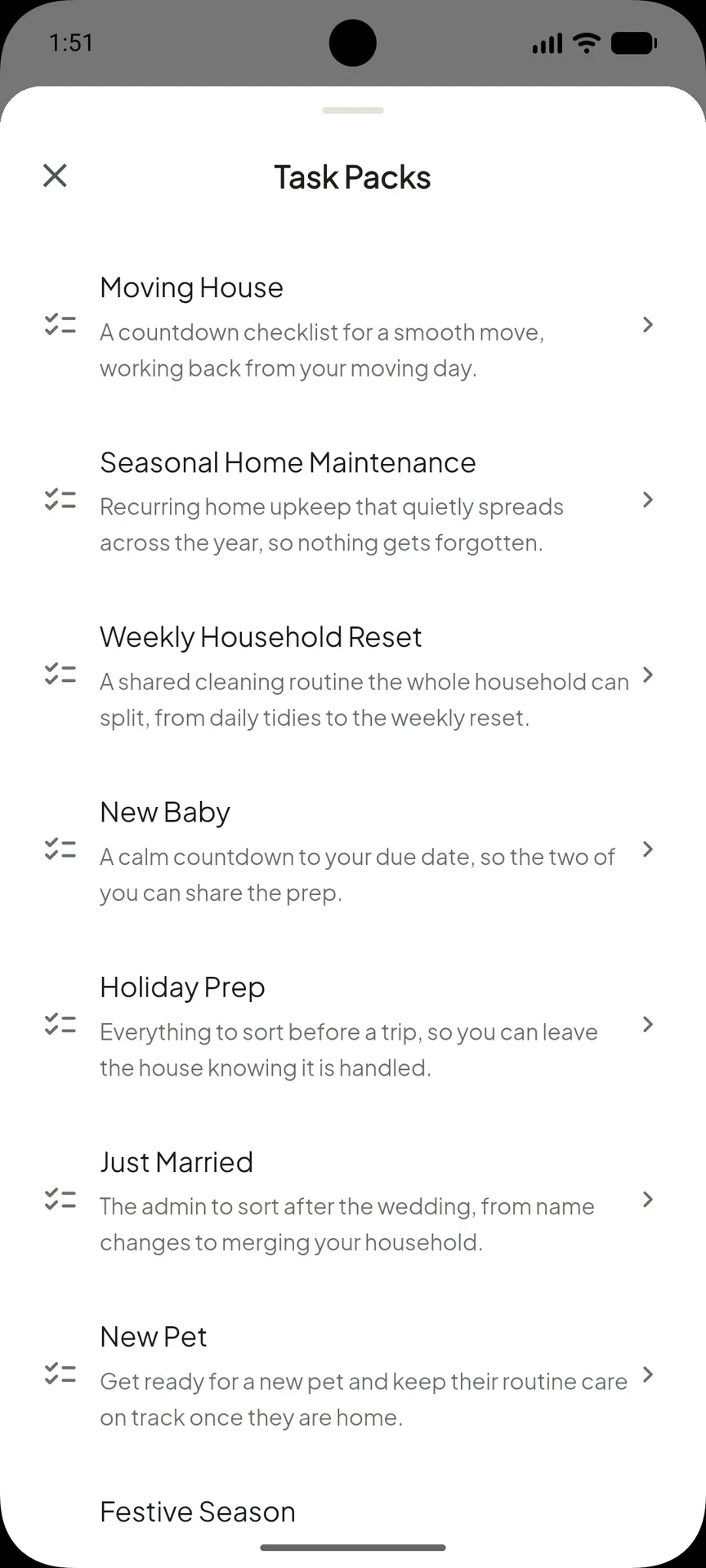
To skip the setup, Task Packs build a lot of this for you. Pick the Car Maintenance pack to schedule a vehicle's recurring jobs in a couple of taps, then customise the rest by hand.
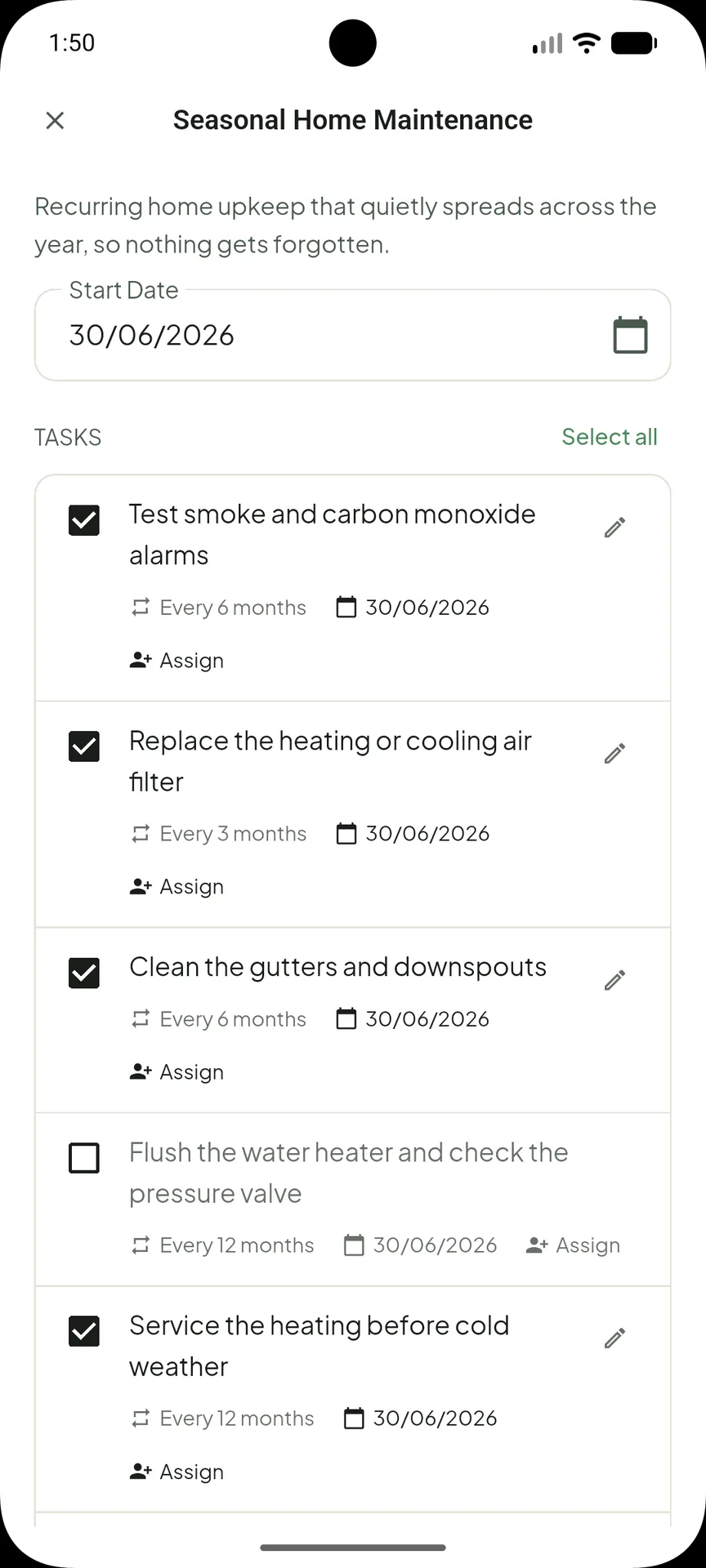
There is a pack for most of the recurring work a household runs on, so you rarely start from a blank slate.
Frequently asked questions
How do I keep track of home maintenance without forgetting things?
Log the items and jobs that carry a date, such as appliances, vehicles and warranties, then turn each date into a reminder that becomes a task someone owns. Add a seasonal checklist for recurring jobs. Once everything lives in one shared place with reminders attached, you stop relying on memory.
What home maintenance tasks should I do each season?
Spring is for clearing gutters and servicing the heating, summer for outdoor woodwork and checking seals, autumn for clearing gutters again and servicing the boiler before the cold, and winter for testing alarms and watching pipes during freezes. A seasonal checklist means each season hands you a short, predictable list rather than something you have to remember.
How often should I service my boiler and test smoke alarms?
A boiler should be serviced once a year, ideally in spring or early autumn before heavy use, and booking ahead of the cold season avoids the rush. Most manufacturers also require an annual service to keep the warranty valid (British Gas, checked June 2026). Smoke and carbon monoxide alarms should be tested at least once a month, the cadence UK fire services consistently advise (Essex County Fire and Rescue Service, checked June 2026). A monthly test works well as a recurring reminder so it keeps coming back on its own.
How can I share home maintenance so it is not all on one person?
Keep the inventory, reminders and tasks in a shared space the whole household can see. In OneHaus, recurring tasks can rotate between members, reminders become shared tasks anyone can pick up, and the calendar syncs with Apple Calendar and Google Calendar so everyone sees what is coming up. The load is spread rather than carried by one person.
What is the easiest way to start tracking home maintenance?
Pick three things with dates in the next six months, such as a car MOT, a warranty running out and the next boiler service. Record the details, set a reminder for each, and build from there. The free Home Maintenance Planner gives you a structured place to capture those first dates.
Where can I keep all of this in one place?
OneHaus keeps your home inventory, recurring reminders, shared tasks and shared calendar together in one app. It runs on iPhone, iPad, Apple Watch and Android, and the natural-language assistant lets you capture jobs by typing or speaking a plain sentence. OneHaus is free to download with a 30-day trial, after which one subscription covers everyone in the household.
Related guides
- The best home maintenance apps in 2026 compares the options for keeping a home maintained.
- How to Track Your Home Inventory: A Simple UK Guide covers what to record and how to capture it fast.
- Home maintenance checklist: seasonal tasks for the year lists the seasonal jobs to work through across the year.
- OneHaus for families shows how a shared system fits a busy household.
- Apps that cover home admin as well as the calendar weighs up the all-in-one options.