OneHaus vs Listonic (2026) | Best Listonic Alternative
Listonic is a strong shared grocery list app with smart aisle sorting, real-time syncing and a genuine web app, and its core list features are free. OneHaus is a whole-household app where the shopping list is one feature alongside rotating chores, a shared calendar, home inventory and an AI assistant. If all you need is a shared list for the weekly shop, Listonic is excellent. If shopping is one of many shared jobs your household juggles, OneHaus covers more.
For this comparison we built a shared grocery list in Listonic, sorted it by aisle and shared it with a second person, then set up the same list in OneHaus alongside rotating chores and a warranty record to see how each handles shared household work.
What is Listonic?
Listonic is a smart shopping list app focused on making the grocery run faster and easier to share. It has been around for years and has built a large product catalogue and a reputation for quick list entry.
Key features include:
- Shared grocery lists that sync in real time across household members
- Automatic aisle sorting, plus A to Z and custom ordering
- Smart autocomplete that suggests common items and learns your frequent buys
- Voice input for adding items hands-free
- Offline mode that syncs changes once you are back online
- Meal planning and recipe ideas, with an AI assistant on newer versions
- Available on iOS, Android and the web, with tablet support
Listonic's core list features are free and ad-supported. There is a paid Listonic Premium subscription that removes ads and lets you change the currency and the app's appearance, sold monthly or annually (pricing varies by region and store, checked September 2026). The free tier is heavy on ads, which is the main trade-off for not paying.
Listonic is particularly strong for households that want a fast, shared list and nothing more. The autocomplete and aisle sorting are well executed, and because it runs in a browser as well as on phones, anyone in the household can open a list on whatever device is to hand.
What is OneHaus?
OneHaus is an AI-powered household management app built specifically for families and shared households. Rather than focusing on a single job like the weekly shop, OneHaus is designed around the idea that a home is a shared system with many moving parts.
Key features include:
- Tasks and chores with automatic rotation and shared assignment
- Shared household calendar synced with Apple Calendar and Google Calendar
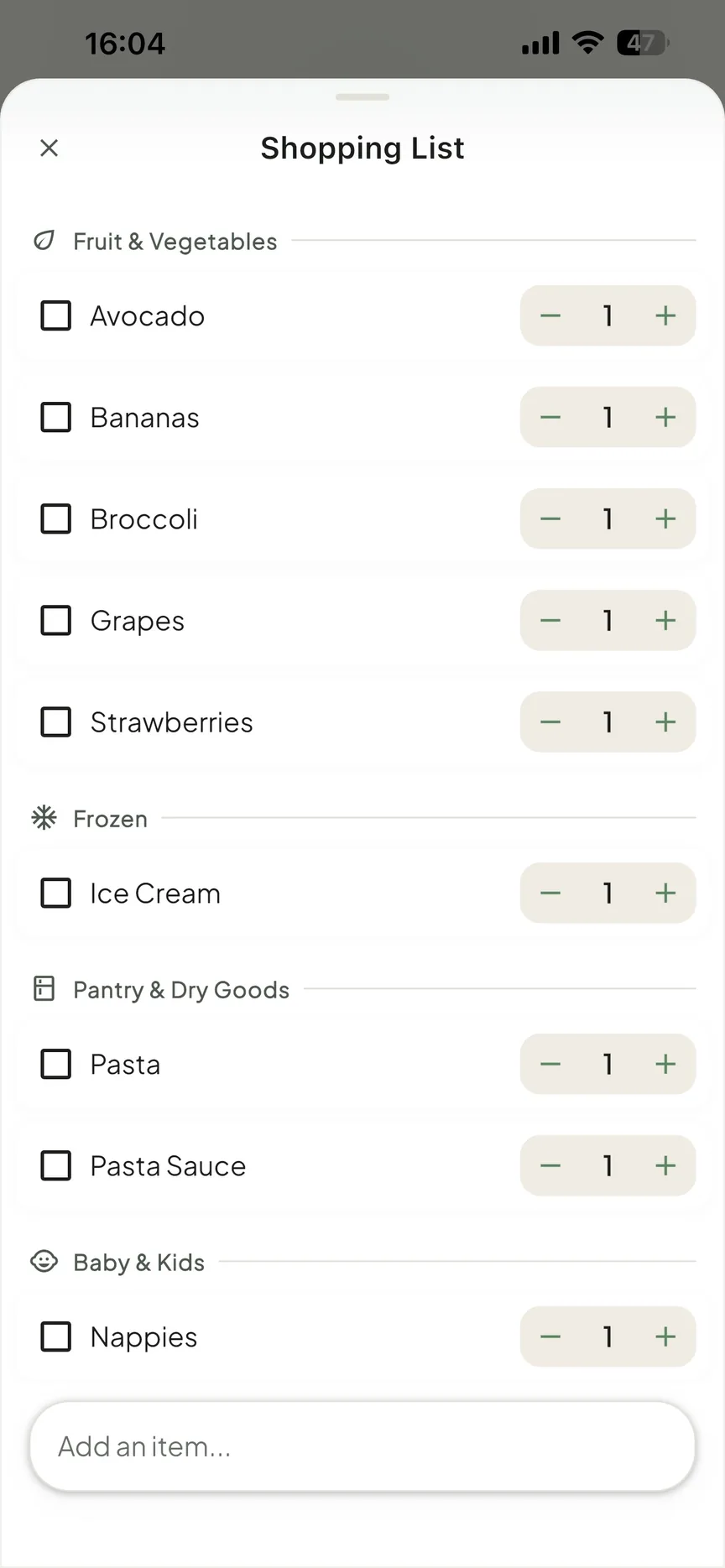
- Collaborative shopping lists with automatic aisle sorting that sync across members
- Home inventory for appliances, warranties, documents, subscriptions and expiry dates
- AI assistant for natural-language input and household management
- Meal planning tied into the shopping list
- Privacy-first design with no third-party advertising
OneHaus brings these areas into a single app so that one person is not left holding the mental load for the whole household. Shopping is part of that, but it sits alongside the chores, the calendar and the paperwork that keep a home running.
Feature Comparison
| Feature | Listonic | OneHaus |
|---|---|---|
| Shared shopping lists | Yes, real-time sync | Yes, synced across members |
| Aisle sorting | Yes, automatic plus A to Z and custom | Yes, automatic |
| Autocomplete and item catalogue | Yes, large catalogue | Yes |
| Voice input | Yes | Yes, via the AI assistant |
| Meal planning | Yes | Yes |
| Chore rotation | No | Yes |
| Shared calendar | No | Yes, synced with Apple and Google Calendar |
| Home inventory | No | Yes |
| AI assistant | Yes, on newer versions | Yes, included |
| Platforms | iOS, Android, web | iPhone, iPad, Apple Watch, Android |
| Web app | Yes | No |
| Pricing | Free, ad-supported; paid Premium removes ads | Free to download, 30-day trial, one household subscription |
Key Differences
A shopping list versus a household app
Listonic does one job and does it well: it is a shared shopping list. Everything in the app serves that goal, from the autocomplete to the aisle sorting. If your household's only shared pain point is the weekly shop, that focus is a genuine strength.
OneHaus treats shopping as one job among several. The shopping list sits next to rotating chores, a shared calendar and a home inventory, all in the same app. That breadth matters when the mental load of running a home is spread across cooking, cleaning, admin and errands, not just groceries.
Chore rotation and shared responsibility
Listonic has no concept of chores or task rotation. It is a list of things to buy, not a system for sharing household work. If you want the washing-up or the bins to alternate fairly between members, Listonic is not built for that.
OneHaus includes automatic chore rotation. Recurring tasks cycle between household members on their own, so the distribution stays fair without anyone having to reassign them each week. That is the difference between tracking what to buy and tracking who does what.
Home inventory and household admin
Listonic keeps its focus on the shop and does not store information about your home. There is no place to record an appliance warranty, a service date or an insurance document.
OneHaus includes a home inventory for appliances, warranties, documents, subscriptions and expiry dates. When a warranty is about to lapse or a subscription is due to renew, OneHaus surfaces it rather than leaving it buried in a drawer. That is a whole category of household admin Listonic does not attempt.
Platforms and where you can open it
Platform reach is where the two apps differ most. Listonic runs on iOS, Android and the web, with tablet support, so you can open a list in a browser on a laptop or work computer without installing anything.
OneHaus is available on iPhone, iPad, Apple Watch and Android, and it connects to AI assistants such as ChatGPT and Claude. It does not currently have a web app. If your household relies on opening lists in a desktop browser, Listonic has the edge here.
Where Listonic Works Better
Listonic has clear advantages for some households:
- Free core features. The shared list, aisle sorting and autocomplete are all available at no cost. If budget is the deciding factor and you only need a list, that is hard to beat.
- Web access. Listonic works in a browser, so anyone can open a list on a laptop or desktop without an app. OneHaus has no web app today.
- Single-purpose simplicity. If you want a shared shopping list and nothing else, Listonic's focus means less to learn and set up.
- Large product catalogue. Years of refinement have given Listonic fast autocomplete and a big item database, which speeds up list entry.
- Maturity. Listonic is a well-established app with a long track record, which some households will prefer.
Where OneHaus Works Better
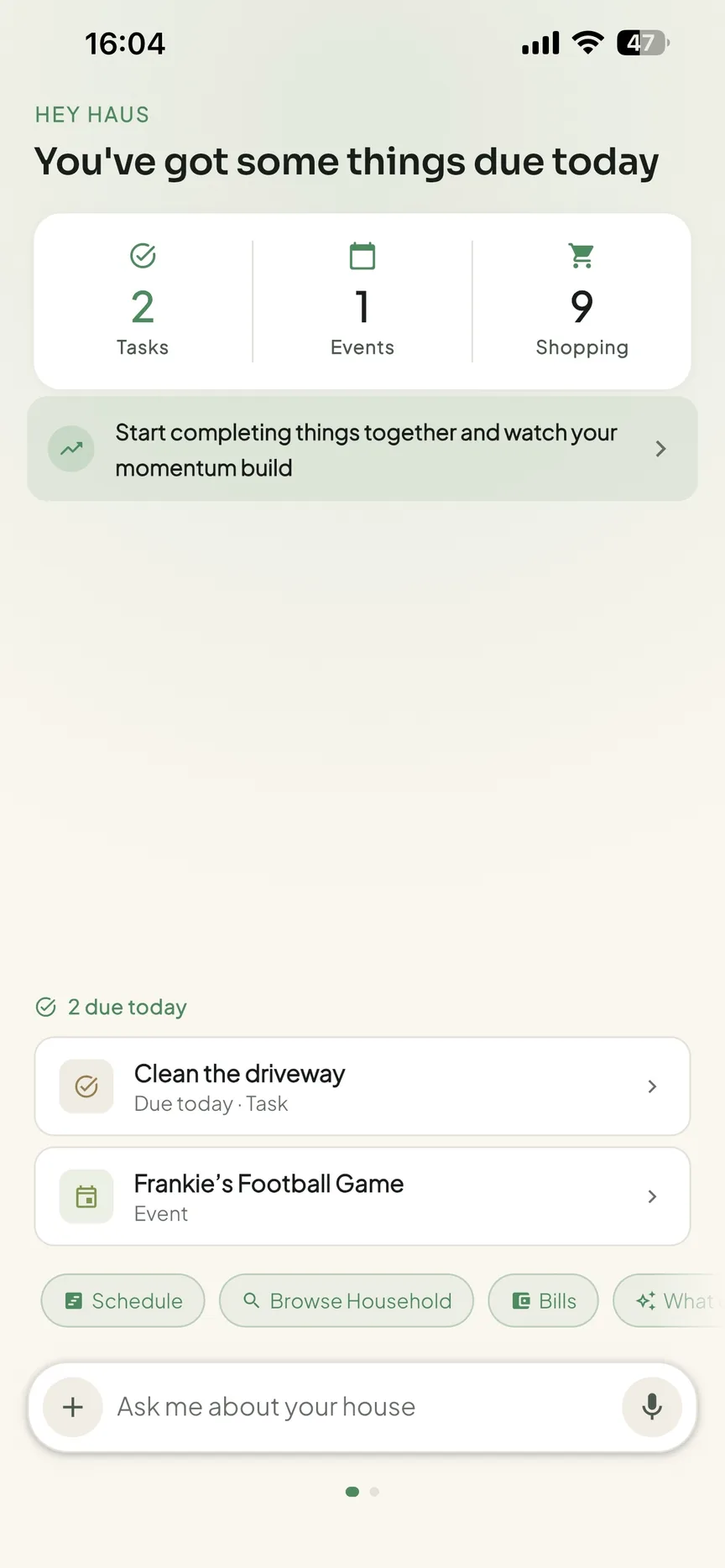
OneHaus has meaningful advantages for shared households that need more than a list:
- Multiple named lists. A house can keep up to 20 separate lists, so the weekly shop, a party and a DIY run do not end up in one running list.
- Chore rotation. Recurring tasks cycle between members automatically, so the work stays fairly shared without weekly reassignment.
- Whole-household scope. Shopping, chores, calendar and inventory live in one app rather than being spread across several tools.
- Home inventory. A single record of appliances, warranties, documents and subscriptions, with reminders before things lapse.
- Shared calendar. A household calendar synced with Apple Calendar and Google Calendar keeps everyone on the same schedule.
- Household AI assistant. The assistant is built around household jobs, adding items, chores and events in natural language, rather than being bolted on to a shopping list.
- No third-party advertising. OneHaus is privacy-first and does not show ads, so the experience stays clean.
Who Should Choose Listonic
Listonic suits you if:
- You want a fast, shared grocery list and little else
- You value a free core experience and are happy to accept ads, or to pay Premium to remove them
- You need to open your list in a web browser on a laptop or desktop
- Your household's main shared task is the weekly shop
- You want a mature, single-purpose app with a strong item catalogue
Who Should Choose OneHaus
OneHaus suits you if:
- You share a home and want more than a shopping list, including chores, calendar and admin
- You want automatic chore rotation so household work stays fairly shared
- You need home inventory tracking for warranties, documents and subscriptions
- You want a shared calendar that syncs with Apple Calendar and Google Calendar
- You want a household AI assistant that understands shared household management
- You are looking for one app to reduce mental load across the whole household, not just groceries
Try OneHaus Free
OneHaus is free to download, with a 30-day free trial and then a single household subscription covering everyone who lives with you. Set up your household, invite the people you live with, and see how it handles shopping alongside chores, calendar and inventory.
Download OneHaus to get started on iPhone, iPad, Apple Watch and Android.
Frequently Asked Questions
Is Listonic free?
Yes. Listonic's core shopping list features, including sharing and aisle sorting, are free and ad-supported. There is a paid Listonic Premium subscription that removes ads and lets you change the currency and app appearance, sold monthly or annually (pricing varies by region and store, checked September 2026).
Is Listonic better than Bring?
Both are strong free shared grocery list apps, so it comes down to preference. Listonic leads on its large item catalogue and flexible sorting, while Bring is known for its visual, icon-led design. If you need chores, a shared calendar and home inventory as well, a whole-household app like OneHaus covers more than either.
Does Listonic have a web app?
Yes. Listonic runs on the web as well as iOS and Android, so you can open your lists in a browser on a laptop or desktop. OneHaus does not currently have a web app; it is available on iPhone, iPad, Apple Watch and Android.
Is OneHaus free?
OneHaus is free to download and comes with a 30-day free trial. After that, it runs on a single household subscription covering everyone who lives together. There is no permanent free tier and no per-person fee.
What does OneHaus do that Listonic does not?
OneHaus adds automatic chore rotation, a shared calendar synced with Apple and Google Calendar, and a home inventory for warranties, documents and subscriptions, all alongside a shared shopping list with aisle sorting. Listonic focuses on the shopping list itself.