Chores by Age: Age-Appropriate Chore Chart for Kids 2-18
Age-appropriate chores for children from toddlers to teens, what each age can realistically handle, and a free printable chore chart you can build in a minute.
Chores & CleaningChildren can start helping around the house far earlier than most parents expect: a two-year-old can put toys in a basket, a five-year-old can lay the table, and a teenager can cook a simple meal and manage their own laundry. The key is matching the chore to what the child can actually do, then letting them grow into more responsibility. Here is the quick map by age:
- 2 to 3: tidy toys, put clothes in the basket, wipe spills.
- 4 to 5: lay the table, feed pets, make their bed, sort laundry by colour.
- 6 to 8: tidy their room, take out recycling, help wash up, water plants.
- 9 to 11: hoover, load the dishwasher, take the bins out, prepare a simple snack.
- 12 to 14: cook basic meals, do their own laundry, clean the bathroom.
- 15 to 18: full meals, manage a budget, deeper cleaning, run errands.
These bands line up with the age-appropriate chore guidance from the American Academy of Pediatrics and the American Academy of Child and Adolescent Psychiatry. The rest of this guide breaks each band down, explains what is realistic (and what is not), and shows how to turn the list into a chore chart children will actually follow. Pocket the age bands above, then read on for the detail.
Why chores matter
Chores are not about free labour. Longitudinal research and plain experience point the same way: children who do regular household jobs grow up more capable, more responsible and better at managing themselves. The work matters less than the habit. A child who learns at six that the household runs on everyone pitching in carries that into adulthood.
The mistake is either asking too much (a frustrated four-year-old told to clean the bathroom) or too little (a sixteen-year-old who has never done their own washing). Pitch the chore just slightly above comfortable, and children rise to it.
The idea that chores build capable adults is not just parental folklore. The most cited evidence comes from Marty Rossmann, a researcher at the University of Minnesota, who analysed a longitudinal dataset following the same children from preschool into their mid-twenties. Her finding was striking: the children who took part in household tasks from the age of three or four were, as young adults, more likely to be self-reliant, to do well academically and early in their careers, and to keep good relationships with family and friends. You can read a fuller write-up of the University of Minnesota research on involving children in household tasks.
A couple of things get overstated online. The link is a correlation, not a guarantee, and the same study sometimes gets attributed to the long-running Harvard Study of Adult Development, whose own headline conclusion is really about the value of good relationships rather than chores specifically. So no, asking a toddler to put their bricks away will not on its own produce a high-flying graduate.
What the evidence does support is gentler and more useful: children who grow up contributing to the running of a home tend to develop a stronger sense of responsibility and competence, and they tend to start younger than most parents assume. Rossmann's data also hinted that starting late is far less effective, which fits everyday experience. A sixteen-year-old handed their first chores often resists; a six-year-old who has always helped barely notices. Start small, start early, and keep it regular.
How to introduce chores without a battle
If chores currently end in a standoff, the problem is usually how they are introduced rather than the child. Building OneHaus, I have watched a lot of families set up shared chores, and the ones that stick almost always start the same way. A few small changes head off most of the friction.
- Start small. One tiny job done willingly beats a long list done resentfully. Begin with a single chore your child can manage in a couple of minutes, and add more only once it is a habit.
- Build in a fixed slot. Chores work best when they are simply part of the day, like brushing teeth, rather than something dangled for good behaviour or threatened for bad. A predictable slot ("we tidy up before tea") removes the daily negotiation.
- Praise the effort, not the result. "Thank you for putting all the cushions back" lands better than silently re-doing it later. Recognising the trying is what makes a child want to do it again.
- Expect age-appropriate imperfection. A four-year-old's made bed will be lumpy and a tween's hoovering will miss the corners. Resist the urge to redo it in front of them, which quietly tells them it was not worth doing.
- Let them choose between options. A child who picks "feed the cat or water the plants?" feels ownership in a way that an imposed task never delivers. Offering a small choice keeps the outcome you want while handing them the control they crave.
Toddlers: ages 2 to 3
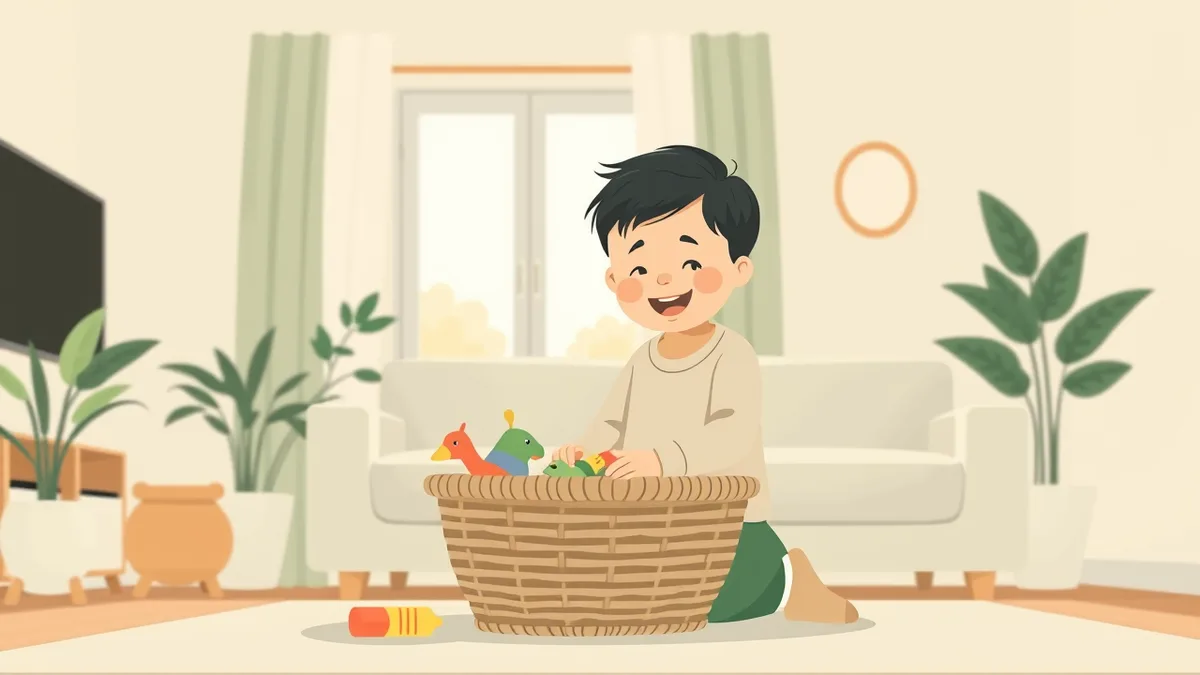
At this age, chores are really play with a purpose. Do not expect a clean result. Expect a child who learns that tidying is just part of the day.
- Put toys away in a basket or box.
- Put dirty clothes in the laundry basket.
- Wipe up small spills with a cloth.
- Stack books or fill a pet's water bowl with help.
- Carry their own (unbreakable) plate to the kitchen.
- Help match the lids to plastic tubs while you unload the dishwasher.
Keep instructions to one step ("put the bricks in the box"), and join in. At this age you are building the association, not the skill.
What they are learning: that tidying up is simply part of using something, and that they belong to a household everyone helps to run. This is the seed of responsibility, long before they could name it.
Young children: ages 4 to 5
A four or five-year-old can follow two-step instructions and genuinely help. This is the age to start a simple, visual chore chart, because they cannot read a long list but they love ticking things off.
- Lay and clear the table.
- Make their bed (loosely; do not expect hospital corners).
- Feed pets and refill water.
- Sort laundry into lights and darks.
- Water plants.
- Help put the shopping away, handing you tins and boxes.
- Dust low surfaces and skirting boards with a cloth.
Pair each chore with a clear picture or icon so a pre-reader can follow it independently. Our chore chart generator builds an age-appropriate, printable chart you can stick on the fridge or share to a phone.
What they are learning: to follow a short sequence of steps and finish a task. Sorting socks or laying the table also quietly builds early counting, matching and sorting skills, which is why this age loves jobs that have an obvious right answer.
School age: ages 6 to 8
Now children can handle multi-step tasks and take ownership of a small area, usually their own room.
- Tidy their bedroom and make the bed properly.
- Take recycling out and sort it.
- Help wash and dry up after meals.
- Put their clean laundry away.
- Set out their school things the night before.
- Make their own breakfast, like cereal or toast.
- Wipe down the kitchen table and surfaces after a meal.
This is a good age to introduce the idea that some jobs are theirs every day, building the routine that makes the teenage years far less of a battle.
What they are learning: ownership. Taking charge of their own room and school bag teaches them to plan ahead and to live with the consequences of forgetting, which is a far gentler lesson at seven than at seventeen.
Tweens: ages 9 to 11
Tweens are capable of real, useful work and want to be trusted with it. Give them jobs that visibly help the whole household, not just themselves.
- Hoover rooms and stairs.
- Load and unload the dishwasher.
- Take the bins out on collection day.
- Prepare a simple snack or part of a meal.
- Walk the dog (where safe) and clean up after pets.
- Strip and remake their own bed with clean sheets.
- Help plan a meal and add items to the shopping list.
A reminder on their own phone or a shared family app works better at this age than nagging. It hands them ownership and takes you out of the role of household enforcer.
What they are learning: that their work helps the whole household, not just themselves. Jobs like hoovering the stairs or putting the bins out are a child's first taste of contributing to the common good, and being trusted with them is part of the reward.
Teenagers: ages 12 to 18
By the teenage years, the goal shifts from "helping out" to "learning to run a home". A 14-year-old who can cook, clean and do laundry is a far more confident 18-year-old leaving for university or work.
Ages 12 to 14:
- Cook a basic meal start to finish.
- Do their own laundry, wash to put-away.
- Clean the bathroom properly.
- Iron simple items.
- Change a bin bag and take the rubbish to the right bin.
- Look after a younger sibling for a short, supervised stretch.
Ages 15 to 18:
- Plan and cook full meals.
- Manage deeper cleaning jobs (oven, fridge, windows).
- Run errands and small shops.
- Help manage a budget or their own subscriptions.
- Compare prices on the weekly shop and stick to a set amount.
- Keep on top of their own admin, like charging the bus pass or booking an appointment.
What they are learning: how to run a home, and increasingly, money sense. A teenager who plans a meal, shops for it within a budget and cooks it has rehearsed the exact skills they will need the week they move out. Handing them a small, real budget (the weekly shop, their own subscriptions) turns abstract advice about money into practice they can feel.
The trick with teenagers is to agree the jobs together rather than impose them, and to let the chore system do the reminding. A shared list everyone can see avoids the "I forgot" and "that's not my job" loops.
A simple age-by-age chore chart
Here is the whole guide in one liftable table, so you can scan the right jobs for each child at a glance.
| Age | Example chores | What they are learning |
|---|---|---|
| 2 to 3 | Tidy toys, put clothes in the basket, wipe spills | Tidying is part of using something |
| 4 to 5 | Lay the table, make their bed, feed pets, sort laundry | Following a short sequence to the finish |
| 6 to 8 | Tidy their room, take out recycling, wash up, set out school things | Ownership of their own space |
| 9 to 11 | Hoover, load the dishwasher, take the bins out, prep a snack | Contributing to the whole household |
| 12 to 14 | Cook a basic meal, do their own laundry, clean the bathroom | Running parts of a home |
| 15 to 18 | Plan and cook full meals, deeper cleaning, manage a budget | Independence and money sense |
Once you have picked a handful of jobs for each child, the easiest way to make them stick is to put them on a chart everyone can see. A good age-by-age chart lists each child's own jobs, shows the days they are due, and leaves room to tick them off, which for younger children is half the appeal.
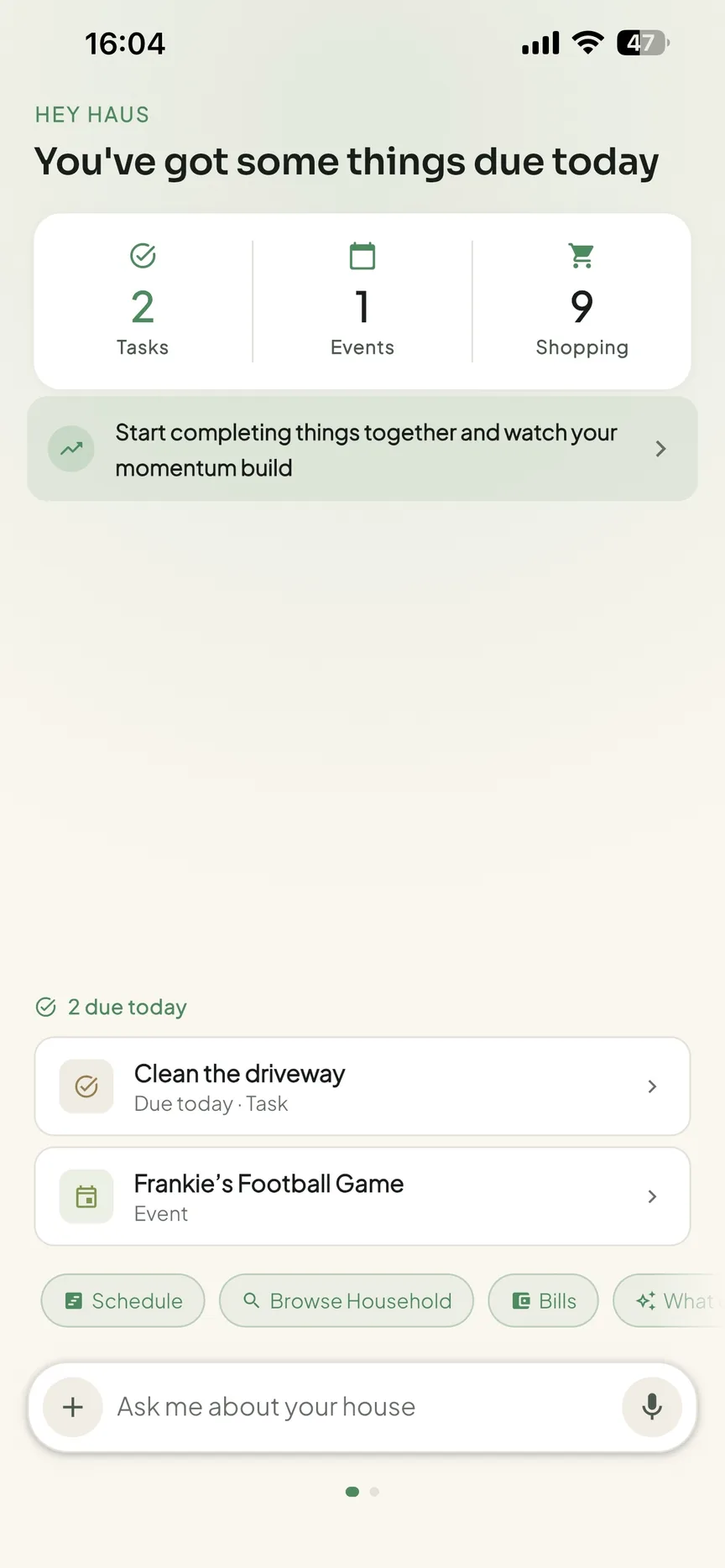
You do not have to design one from scratch. Our chore chart generator takes the ages of your children and builds a printable, age-appropriate chart in a moment, with picture-friendly tasks for the little ones and fuller lists for older kids. Print it for the fridge, or assign the same jobs in OneHaus so the chart lives on everyone's phone and reminds them itself.
Make the list stick
A chore list only works if it is visible, fair and self-reminding. A few things make the difference:
- Match the chore to the age, then nudge slightly upward. Too easy and they coast; too hard and they give up.
- Keep it fair across siblings. Use effort, not just job count, so an older child's harder tasks are recognised. Our chore fairness calculator helps balance the load.
- Put it where children already look: a chart on the fridge for little ones, a shared app for older kids. OneHaus lets you assign recurring chores to each child, with reminders that fire on their own device, so the household stops depending on you to chase everyone.
Want the whole family pulling their weight without the daily reminders coming from you? Download OneHaus and give every child their own jobs and nudges. Chores and tasks are free on every OneHaus household. See how it works for families with children of every age.
Frequently asked questions
What should be on a chore chart for kids?
Each child's own jobs, the days they are due, and a space to tick them off. Keep it short: one or two jobs for a toddler, three or four for a school-age child, and a slightly fuller list for a tween or teenager. Match the jobs to the age using the table above, put the chart where the children already look (the fridge for younger ones, a shared app for older ones), and rewrite it every few months as they grow into more. Our chore chart generator builds a printable one from your children's ages if you would rather not draw it yourself.
Should a chore chart have rewards?
It depends on what you want the chart to teach. Rewards work well for a short push, such as getting a new routine started or through a busy few weeks, but tying every job to a payment can turn contributing to the household into a transaction to be negotiated. A common middle ground is to keep basic jobs (tidying their own room, clearing their plate) unpaid as a normal part of living there, and attach pocket money to bigger optional jobs like washing the car.
What chores can a 5-year-old do?
A five-year-old can lay and clear the table, make their bed loosely, feed pets, sort laundry into lights and darks, water plants and tidy their toys. Keep instructions to one or two steps and use a picture-based chart so a pre-reader can follow it. The result will not be perfect, and that is fine: the point is the habit, not the finish.
What are good chores for teenagers?
Teenagers should be learning to run a home, not just helping out. Good chores include cooking full meals, doing their own laundry start to finish, cleaning the bathroom, deeper jobs like the oven and fridge, running errands and managing a small budget. Agree the jobs together rather than imposing them, and let a shared app handle the reminders so it does not become a daily argument.
Should children be paid for chores?
There are two schools of thought. Many families keep everyday chores (tidying, laying the table) unpaid as a basic contribution to the household, then pay pocket money for bigger optional jobs like washing the car. This separates "what we all do because we live here" from "extra work you choose to earn from". Whichever you choose, be consistent so the expectation is clear.
How do I get my kids to actually do their chores?
Make the chores age-appropriate, visible and self-reminding. A job that is too hard gets abandoned; one hidden in your head gets forgotten. Use a chart for young children and a shared app for older ones, assign each child their own tasks, and let reminders do the chasing. Recognising effort fairly across siblings also stops the "it's not fair" complaints that derail most chore systems.
At what age should children start doing chores?
Earlier than most parents think. A two or three-year-old can put toys away, drop clothes in the laundry basket and wipe up a spill, and starting this young is exactly what the research points to: children who help from three or four tend to grow into more capable, responsible adults. At this age it is really play with a purpose, so do not expect a clean result. The point is the habit, not the finish, and a child who has always helped barely questions it later.
How many chores should a child have?
Fewer than you might guess, especially at first. One or two regular jobs a young child can actually manage beats a long list that ends in tears for both of you. As they get older and the routine settles, add more and mix daily jobs (tidy your room) with weekly ones (hoover the stairs) so it does not feel like the same grind every day. The aim is a load that is noticeable but not overwhelming, then nudged up a little as they grow into it.